Eastern Times News Editorial Note
This article follows Eastern Times News’s commitment to viewing South Asia from its margins rather than reproducing the political gaze of national capitals. It rejects both state propaganda and the romantic claim that every crowd represents an imminent revolution. The article recognises the courage and organisational achievements of the AJK movement while interrogating its leadership, internal accountability and strategic limitations. It treats official allegations of armed infiltration as claims requiring investigation, but refuses to let those allegations erase documented deaths, communications blackouts and mass arrests. Most importantly, it resists reducing Pakistan’s youth politics to PTI or to metropolitan social-media culture. Baloch, Pashtun, Kashmiri, feminist, labour and student mobilisations belong within the same national analysis, even where their programmes and histories differ. Eastern Times News regards democratic journalism not as neutrality between power and its victims, but as disciplined independence from governments, militaries, parties and movement mythologies alike.
When polling stations opened in Muzaffarabad on 2 August, the capital of Pakistan-administered Azad Jammu and Kashmir did not resemble a city celebrating an election. Markets, banks and petrol stations had been closed, public transport was suspended, and the streets had already endured two days of shutdown. An intermittent communications blackout, by then extending beyond fifty days, had impaired reporting, banking, political campaigning and ordinary family contact. Groups of young men gathered not to canvass for candidates but to denounce an election they believed was being conducted beneath the shadow of deaths, arrests and coercion. Turnout remained below the levels recorded in the previous two regional elections, despite the Election Commission’s claim that almost half of registered voters participated.
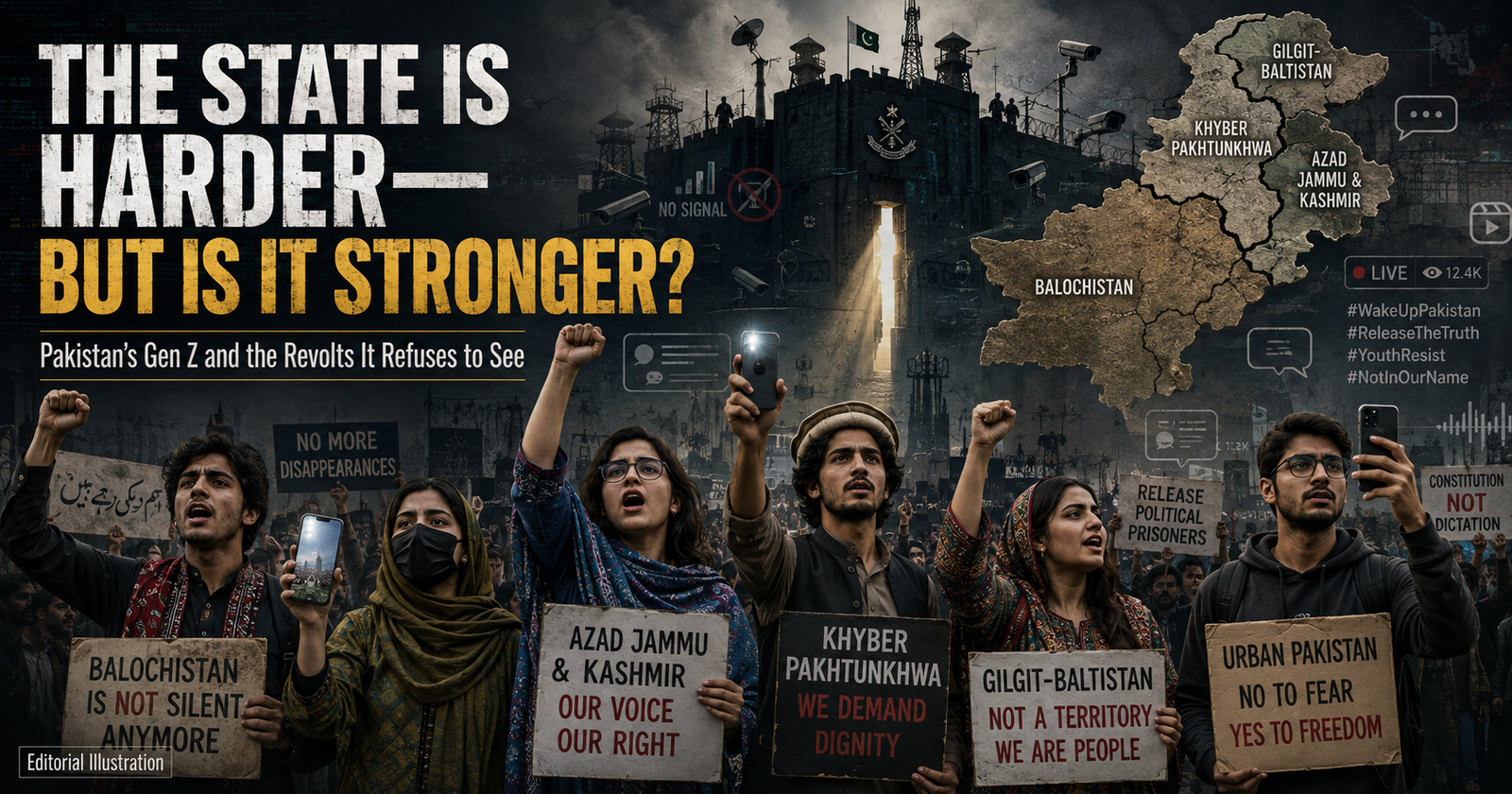
This is where Pakistan’s supposed absence from South Asia’s “Gen Z moment” should be examined: not in a television studio in Islamabad asking why Pakistani youth do not imitate Delhi, but in a region where young people have continued to mobilise despite internet suspension, anti-terrorism designations, mass detention and lethal violence.
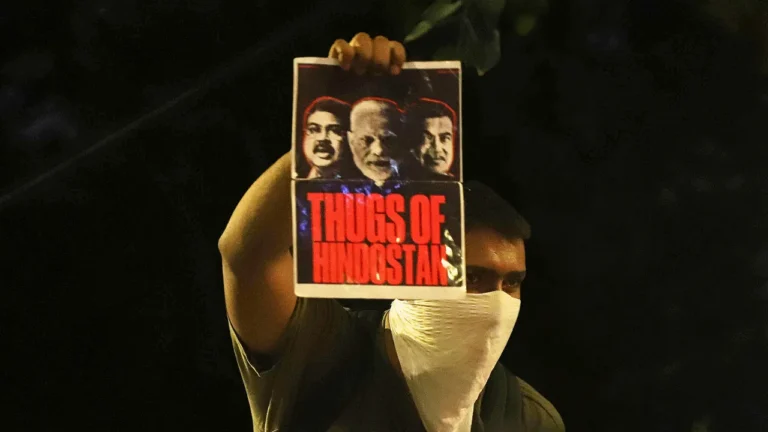
The rise of India’s Cockroach Janta Party has nevertheless produced a revealing Pakistani debate. After an examination-paper scandal became a nationwide youth movement challenging Narendra Modi’s government, commentators began asking why Pakistan’s Gen Z remained silent. Some framed Pakistani youth as politically unserious, distracted by entertainment, consumed by migration dreams or imprisoned within partisan fandom. An Indian media narrative went further, describing Pakistan as South Asia’s apparent exception to the wave of youth revolt, while Pakistani commentary warned that a demographic dividend deprived of jobs and democratic freedoms could become a demographic disaster.
The debate begins with a false premise. Pakistan does not lack youth resistance. It lacks a nationally accepted political language capable of recognising all its young resisters as members of the same generation.
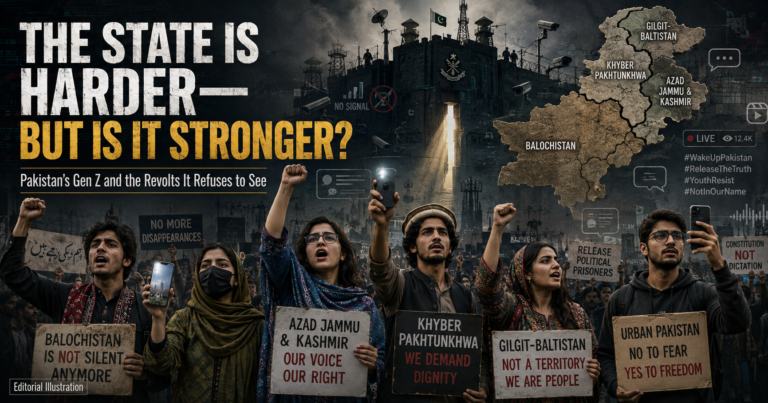
A young middle-class supporter producing memes for Pakistan Tehreek-e-Insaf is readily described as politically awakened. A young Baloch woman marching against enforced disappearances is frequently treated as a security problem. A Pashtun activist questioning military policy is accused of serving an external agenda. A Kashmiri demanding control over resources and representation is designated a terrorist. A female student protesting harassment is told she has been manipulated by social media. Young people are visible as “Gen Z” when their politics is metropolitan, technologically fashionable and recognisable to the dominant national audience. When the same generation speaks from Gwadar, Turbat, Wana, Parachinar, Gilgit, Rawalakot or Muzaffarabad, it is pushed outside the national category and placed inside the security file.
Pakistan’s problem, therefore, is not the absence of revolt. It is the political architecture that keeps revolts separate.
Pakistan’s Gen Z Is Already in the Streets
The largest organised youth constituency in Pakistan remains associated with PTI. During the 2024 general election, the party used virtual rallies, artificial-intelligence-generated speeches, covert neighbourhood canvassing and digital systems that helped voters identify candidates and polling stations. Women volunteers campaigned discreetly when visible party activity attracted arrests or police pressure. Young voters turned out despite the loss of PTI’s electoral symbol, restrictions on campaigning and a nationwide suspension of mobile services on polling day.
That was not political passivity. It demonstrated a substantial capacity for digital mobilisation, improvised organisation and electoral defiance. But it was predominantly a party-centred mobilisation built around Imran Khan’s charisma and the claim that an establishment-backed order had stolen PTI’s mandate. It did not automatically become a movement for democratising all state institutions or defending every community subjected to coercion.
Outside PTI’s orbit, young people have entered politics through struggles that the national media rarely places within a common frame. The Baloch Yakjehti Committee transformed the issue of enforced disappearances into a mass civic campaign, drawing women, students and families of missing persons into long marches and public gatherings. Its leading activists were arrested in March 2025, and Mahrang Baloch and Sibghatullah Shah Jee were sentenced to life imprisonment in June 2026 after proceedings that Amnesty International described as a secret, unfair trial lacking direct evidence connecting them to the alleged killing on which the case rested. The Balochistan government has defended the convictions, while lawyers have announced appeals.
The Pashtun Tahafuz Movement has similarly mobilised a generation shaped by war, displacement, landmines, disappearances and military operations. The federal government proscribed it in 2024 under anti-terrorism law, a measure Amnesty International said targeted peaceful association and minority activism. Reports of PTM members disappearing after contact with officials continued into 2026.
Women’s movements, student solidarity networks, campaigns against university fee increases and harassment, climate activists and gig workers have created additional spaces of youth politics. Yet they rarely converge. The progressive student may distrust the PTI supporter; the PTI supporter may dismiss the Baloch organiser; the metropolitan feminist may possess few organisational links with rural working women; ethnic-national movements may regard Punjab-based democrats as selective allies who speak only after repression reaches the centre.
The state did not create all these divisions. Pakistan’s social hierarchy, ethnic inequality, patriarchal structures, religious sectarianism and competing national narratives preceded the present government. But the military-dominated order has repeatedly exploited them. It contains dissent not only by arresting people but by controlling which victims may be publicly mourned, which movements may appear on television and which grievances can be discussed without attracting accusations of treason.
AJK and the Anatomy of a Popular Front
The Jammu Kashmir Joint Awami Action Committee offers a more instructive Pakistani comparison with the CJP than any attempt to reproduce the Indian movement’s name, memes or visual language.
The JAAC’s roots lie in local protests beginning in 2023 over soaring electricity charges, shortages and alleged smuggling of subsidised flour. Traders stood prominently in the alliance, but transporters, lawyers, students, civic groups and neighbourhood networks widened its social reach. In May 2024, its long march towards Muzaffarabad produced a crisis in which three protesters and one police officer were killed and more than one hundred people were injured. Prime Minister Shehbaz Sharif approved approximately Rs24 billion for reduced electricity tariffs and wheat subsidies, after which the committee ended its march.
The victory mattered because it demonstrated that collective economic disruption could force a reluctant state to concede. The alliance had not won through a parliamentary opposition party, an iconic national leader or a sympathetic television campaign. It had combined commercial shutdowns, transport stoppages, local committees and a demand understood in nearly every household: if the region generates hydropower, why should its residents pay unaffordable electricity prices while political and bureaucratic elites retain privileges?
The movement broadened in 2025. Its 38-point charter included economic relief, action against alleged corruption, improved education and health services, infrastructure, restoration of student unions, curtailment of elite privileges and abolition of twelve legislative seats reserved for refugees from Indian-administered Kashmir living elsewhere in Pakistan. The JAAC argues that these constituencies allow Pakistan-based political networks to influence the formation and removal of AJK governments. Islamabad and AJK political parties maintain that the seats represent displaced Kashmiris and cannot simply be erased administratively.
Negotiations collapsed in September 2025 over the refugee seats and elite privileges. A region-wide strike followed under a communications blackout. At least eight people—five civilians and three police personnel, according to officials cited by Reuters—were killed during four days of violence. A subsequent agreement reportedly accepted most demands, but the government and JAAC continued to dispute how many had actually been implemented.
In 2026, the refugee-seat dispute became inseparable from the regional election. Talks failed at the end of May. On 5 June, the AJK authorities placed JAAC on the schedule of proscribed organisations under the territory’s Anti-Terrorism Act, suspended internet and mobile services and advised visitors to leave before a planned 9 June strike. Amnesty International described the ban as disproportionate and unlawful, arguing that a grassroots rights movement had been branded terrorist while the region was cut off from external scrutiny.
The government presents a different account. Officials say most of the JAAC charter had been implemented, that the refugee seats are constitutionally protected, and that armed men—including alleged Pakistani Taliban infiltrators—entered protest encampments, attacked security personnel and attempted to sabotage the election. Officials displayed videos they said showed masked gunmen and recorded confessions from detained suspects. These claims require independent investigation rather than automatic acceptance or dismissal. The communications blackout, restricted media access and failure to publish a comprehensive casualty record make independent verification exceptionally difficult.
By 19 June, Reuters reported at least twenty civilians and four police officers killed, ninety-seven officers wounded and 515 people detained. Later violence in July drove estimates higher. Amnesty said on 28 July that at least forty people, including thirty-four protesters and six police or paramilitary personnel, had died; residents and local organisations have placed the toll above fifty, while JAAC has claimed more than sixty civilian deaths. No consolidated official toll has been published.
The movement is not exclusively, or even primarily, a Gen Z organisation. Its strength is multigenerational. Traders can close markets; transporters can immobilise roads; lawyers can challenge detention; diaspora networks can amplify information; experienced organisers can negotiate; young volunteers can coordinate, document and rapidly circulate events. To describe it simply as a youth uprising would erase the infrastructure that made sustained defiance possible.
But young people have supplied much of its public energy and borne a large share of its physical risk. In Muzaffarabad during the August voting, first-time voters described refusing to participate after deaths in Rawalakot, Mirpur and Kotli. Others gathered in public squares to argue that an election conducted without accountability for the crackdown could not restore political legitimacy.
This makes JAAC more than an episode of regional anger. It is a test of whether Pakistan’s state can recognise organised civic pressure without redefining it as terrorism.
What the “Hard State” Was Supposed to Achieve
The phrase “hard state” entered Pakistan’s current political vocabulary through Field Marshal Asim Munir’s March 2025 address to the Parliamentary Committee on National Security. Speaking after escalating militant violence and the Jaffar Express attack, he linked terrorism to governance failures and argued that Pakistan needed better governance to become a hard state. He asked how long the armed forces would continue to fill civilian governance gaps through soldiers’ sacrifices.
Taken literally, a hard state need not be an authoritarian state. In Gunnar Myrdal’s original usage, a “soft state” was one unable or unwilling to enforce laws impartially, collect taxes, restrain privileged interests or implement public policy. A democratic hard state would apply law to generals, judges, landowners, corporations, religious organisations and ordinary citizens alike.
Pakistan’s actual transformation has proceeded differently. “Hardness” has become increasingly visible in restrictions on assembly, anti-terrorism prosecutions, control over digital communications, electoral management and the constitutional consolidation of military authority. In November 2025, parliament approved changes creating the position of Chief of Defence Forces, placing the army chief above all three armed services and granting the office-holder lifetime legal immunity after the completion of his term. The amendment also moved constitutional jurisdiction from the Supreme Court to a newly created Federal Constitutional Court whose appointments are more directly shaped by the governing coalition.
This is not classical martial law. Parliament has not been formally abolished, political parties continue to operate, elections are held, and civilian ministers administer daily government. “Military junta” captures the concentration of decisive power as a polemical description, but it is not the most exact institutional category. Pakistan now more closely resembles a constitutionally entrenched military-dominant regime: civilian institutions remain, but the military leadership determines the boundaries within which meaningful politics can occur.
Carnegie scholars Zoha Waseem and Yasser Kureshi describe the present consolidation as one of the most significant formal expansions of military dominance in Pakistan’s recent history. Their crucial observation is that embedding military power within constitutional structures also concentrates responsibility at the top. The regime gains authority but loses the ability to blame civilian governments for every failure.
Coercive Strength, Political Failure
Has the hard-state project failed? The answer depends on what is being measured.
In coercive terms, it has not failed. The state can block internet access across an entire region, deploy paramilitary forces, proscribe movements, arrest hundreds of activists and conduct elections despite boycotts and continuing violence. It has restricted PTI, banned PTM, imprisoned Baloch organisers and prevented geographically separate movements from producing a sustained nationwide confrontation.
Its digital coercive capacity has also expanded. Amnesty International’s 2025 investigation found that Pakistan’s Lawful Intercept Management System could facilitate monitoring of at least four million mobile phones at once, while a web-monitoring system could inspect and block millions of internet sessions. The government did not answer Reuters’ detailed questions about the report; intelligence and defence institutions had earlier denied possessing phone-tapping capacity, although the telecommunications regulator acknowledged requiring operators to connect to the interception system.
A state with these capabilities cannot be described as simply collapsing.
Yet coercion is not consent. Proscribing three major popular movements does not demonstrate that their grievances have disappeared. It demonstrates that the state increasingly encounters political demands through anti-terrorism frameworks. An authority that can disperse a crowd but cannot persuade it, that can hold an election but cannot restore confidence in it, and that can silence regional journalism but cannot generate trusted information is hard without necessarily being strong.
The economic foundations of consent are equally weak. Pakistan has an estimated 46.3 million people between fifteen and twenty-four. The 2024–25 Labour Force Survey placed youth unemployment at 12.8 percent, nearly twice the national rate, while 28.4 percent of young people were outside employment, education or training. The World Bank has warned that Pakistan must create up to thirty million jobs over the next decade to absorb its expanding workforce and reduce the pressures driving instability and migration.
These figures do not automatically produce revolution. Unemployment can generate emigration, depression, criminal economies, religious recruitment, political withdrawal or dependence on patronage. Anger becomes a movement only when organisations give it language, targets and collective confidence.
The hard state’s most serious failure is therefore not that citizens have become impossible to repress. It is that coercion increasingly substitutes for political incorporation. Balochistan, Khyber Pakhtunkhwa and AJK are treated less as constituencies to be persuaded than as territories whose grievances must be managed through security. This may preserve immediate order while deepening the belief that constitutional participation is unable to alter the distribution of power.
Why a National Youth Coalition Has Not Emerged
India’s CJP mobilised around an unusually transferable grievance. Competitive examinations connect millions of households across caste, region and class because they represent one of the few accepted routes into secure employment. A paper leak converted private disappointment into a shared accusation: the promised meritocratic gateway had been corrupted.
Pakistan possesses comparable grievances—unemployment, recruitment corruption, electricity prices, examination failures, university fees, inflation, internet censorship and manipulated elections—but none has yet become a universally recognised national bridge.
The educational system itself is fragmented. Elite private universities, underfunded public campuses, religious seminaries, professional colleges and rural institutions produce radically different political worlds. The 1984 suppression of student unions removed an institutional arena in which young people might have learned representation, coalition-building, debate and accountable leadership. All subsequent civilian governments have failed to restore a functioning national system of elected student unions.
Party polarisation creates another barrier. A PTI supporter may regard all politics through the imprisonment of Imran Khan; a PPP or PML-N supporter may interpret PTI mobilisation as an attempt to restore a former establishment favourite; ethnic-national movements remember that mainstream parties often discovered civil liberties only after losing access to power. Shared opposition to one military leadership does not erase these histories.
There is also a hierarchy of risk. A middle-class activist in Lahore may face arrest, an FIR or online harassment. A Baloch or Pashtun organiser may fear disappearance, prolonged incommunicado detention or anti-terror prosecution. A rural woman may require family permission, safe transport and protection from social retaliation before attending a public meeting. “Why does Gen Z not come out?” is an inadequate question when coming out does not carry the same cost for everyone.
Migration further disperses pressure. For many educated Pakistanis, the imagined solution is not to reorganise the state but to exit it. This reduces the number of people prepared to invest years in political organisation, even as diaspora communities can amplify domestic movements and provide resources.
Can Digital Culture Break the Fear?
Pakistan already possesses the digital skills required for CJP-style mobilisation. PTI proved that a restricted party could use virtual rallies, AI-generated messages, volunteer databases and decentralised online communication to survive an official campaign designed to make it invisible. Young Baloch, Pashtun and Kashmiri activists have similarly used short videos, livestreams and diaspora networks to contest television silence.
The barrier is not technological innocence. It is technological asymmetry.
The state controls telecommunications infrastructure, legal regulation, surveillance capacity and access to platforms. It can slow networks, block X, suspend mobile service, identify organisers and criminalise content after it has circulated. Protesters may win individual narrative battles while remaining vulnerable at the organisational level.
Meme culture also has intrinsic limits. Ridicule can puncture the spectacle of invincibility, but it cannot draft an electricity policy, negotiate a constitutional amendment or maintain a strike fund. Viral content privileges the most dramatic images and personalities, often making invisible the lawyers, drivers, cooks, medical volunteers and neighbourhood organisers who sustain resistance after the algorithm moves on.
The Pakistani discussion of CJP has already demonstrated this danger. The phrase “Where is Pakistan’s Gen Z?” became more shareable than the slower question: what institutions would allow Baloch, Pashtun, Kashmiri, Punjabi, Sindhi, Gilgit-Baltistani, feminist, labour and party-based youth to trust one another?
PTI, Charisma and the Capture of Youth Anger
No analysis of a possible Pakistani Gen Z uprising can bypass PTI. It has politicised millions who previously viewed military dominance as either normal or beneficial. The repression of the party, imprisonment of its leadership and controversy surrounding the 2024 election have taught many urban and semi-urban Pakistanis what Baloch, Pashtun and left-wing activists had long said about unelected power.
This transformation is politically significant. It is also incomplete.
PTI’s own rise was facilitated by the establishment before the relationship collapsed. Its governments did not dismantle the security laws and institutional practices now used against it. Party discourse remains heavily centred on the treatment of Khan, while solidarity with other persecuted movements is inconsistent. Its digital structure is sophisticated, but its political imagination frequently remains charismatic: the movement’s unity rests on the leader rather than autonomous organisations capable of surviving him.
PTI could become part of a democratic youth coalition, but it cannot credibly constitute the whole coalition unless it recognises that constitutional freedom must apply to opponents, ethnic movements, women’s organisations and dissident journalists—not only to its own members.
The same standard applies to every movement. JAAC cannot demand state transparency while leaving its own funding and decision-making opaque. Baloch or Pashtun movements cannot build nationwide solidarity by treating every Punjabi citizen as an extension of the establishment. Progressive organisations cannot defend democracy while dismissing PTI voters as politically ignorant. A coalition will require mutual criticism without mutual erasure.
From Regional Revolts to a Shared Programme
Pakistan could experience a broad Gen Z-centred uprising, but it is unlikely to resemble the CJP exactly. Its most plausible form would be a federation of already existing struggles rather than the sudden creation of a single satirical brand.
Such a movement would require a grievance that crosses social boundaries and an organisational structure that protects difference. A common programme might connect fair employment, restoration of student unions, freedom from enforced disappearance, affordable energy, internet access, credible elections, provincial resource rights, an end to elite privileges and the subordination of all institutions—including the armed forces—to constitutional accountability.
The organisational lesson of AJK is particularly important. Digital communication accelerated the movement, but its real power came from committees embedded in everyday economic life. Traders could close shops, transporters could stop vehicles, lawyers could provide representation, and communities could feed demonstrators. This is far more durable than followers attached to an Instagram account.
The lesson of CJP is different but complementary. Authoritarian power is also cultural. It survives by cultivating awe, fear and the expectation that resistance is futile. Humour can break that expectation. A successful Pakistani movement would need both the committee and the meme, both economic disruption and narrative imagination, both local roots and national circulation.
The State May Be Harder, but Is It Stronger?
Pakistan’s hard-state project has not failed as an apparatus of coercion. It has expanded military authority, disciplined civilian institutions, constrained opposition parties, developed mass-surveillance capacity and repeatedly isolated regional uprisings.
It has failed, however, to manufacture durable consent. It has not convinced large sections of Baloch, Pashtun, Kashmiri or PTI-aligned youth that the existing order represents them. It has not supplied enough secure employment, restored confidence in elections, normalised civilian supremacy or created credible channels through which peaceful mobilisation can compel reform without bloodshed.
The result is not an immediately collapsing state. It is a brittle one: heavily armed, internationally useful, administratively intrusive and politically insecure.
The AJK uprising does not yet prove that Pakistan’s separate rebellions are converging. In fact, its regional isolation may demonstrate that the hard state still knows how to contain them. But the movement has revealed the limit of containment. A government can lower electricity prices after a march, sign an agreement after a shutdown, ban the organisation when negotiations fail and conduct an election under blackout. What it cannot do through force alone is make the underlying question disappear: who owns the state, its resources and its institutions?
Pakistan’s Gen Z is not waiting to be born. It is already present—in party networks, women-led marches, students’ campaigns, missing-persons camps, shuttered bazaars and streets sealed by paramilitary forces.
The unresolved question is whether these young people will continue to encounter one another as rival constituencies, or recognise that the hard state survives precisely by ensuring that they never become a common democratic public.
Fact-Check and Disputed-Claims Note
Casualty totals: No single independently verified figure covers all AJK violence since June 2026. Reuters reported at least twenty civilians and four police officers killed by 19 June. Amnesty International subsequently placed the total at forty by 28 July, including thirty-four protesters and six security personnel. Local estimates exceeded fifty, while JAAC claimed more than sixty civilian deaths. The government has not published a consolidated list. The article therefore attributes all totals rather than presenting one as definitive.
Allegations of armed infiltration: AJK and federal officials allege that armed protesters, snipers and Pakistani Taliban-linked individuals infiltrated demonstrations. They displayed footage and recorded statements from detainees. The provenance, voluntariness and full evidentiary context of these materials have not been independently established. JAAC’s responsibility for any armed actors therefore remains disputed.
JAAC’s legal status: The organisation was proscribed on 5 June 2026 under the AJK Anti-Terrorism Act. Amnesty International considers the designation unlawful and disproportionate. The authorities maintain that violence and threats to public order justified the action.
Implementation of the 38-point charter: Government and political representatives have variously said thirty-five or thirty-seven demands were implemented. JAAC disputes the adequacy and completion of implementation. The article does not adopt either numerical claim as settled fact.
Refugee seats: The twelve constituencies are reserved for people displaced from Indian-administered Kashmir and living in Pakistan. The AJK Supreme Court has held that the seats are constitutionally protected and require legislative constitutional action rather than an executive order for abolition. JAAC argues that the seats enable outside political manipulation. Both legal protection and political controversy are therefore real.
Election status: As of 4 August 2026, two phases had been completed. Election officials said PML-N had won fourteen of eighteen declared seats and PPP four; voting in Poonch division was scheduled for 10 August. These are provisional, incomplete results, and allegations of boycotts, violence and rigging remain contested.
“Military junta”: Pakistan is not under formally declared martial law. The phrase may communicate military supremacy politically, but “military-dominant hybrid regime” or “constitutionalised military rule” more precisely describes a system retaining parliament, elections and civilian government while granting extraordinary formal and informal authority to military leadership.
Social-media debate: Viral posts asking why Pakistan lacks a Gen Z uprising are not scientific evidence of national opinion. The analysis treats them as a discourse produced by journalists, influencers and politically engaged users—not as a representative survey of Pakistani youth.
AJK Movement: Condensed Timeline
| Period | Development |
|---|---|
| May–September 2023 | Local protests develop around electricity charges, flour shortages and alleged smuggling. A region-wide civic coalition begins to take shape. |
| May 2024 | JAAC leads a long march and shutdown. Three protesters and one police officer are killed. The federal government approves roughly Rs24 billion for flour and electricity subsidies; the march ends. |
| December 2024 | Mass mobilisation forces withdrawal of a restrictive public-assembly ordinance. |
| September–October 2025 | JAAC presents a 38-point charter. Talks fail over elite privileges and twelve refugee seats. A region-wide shutdown and communications blackout follow; at least eight people are killed according to officials. An agreement is later signed. |
| May 2026 | Negotiations over unresolved demands and the refugee-seat question end without agreement. |
| 5 June 2026 | JAAC is proscribed under AJK anti-terrorism law. Internet and mobile services are suspended before a planned strike. |
| 6–19 June 2026 | Violent clashes, deaths, mass detention and a territory-wide shutdown occur. Reuters reports at least twenty civilians and four officers killed by 19 June. |
| July 2026 | Further marches and clashes increase the disputed death toll. Elections are divided into three phases because of security concerns. |
| 27 July 2026 | First electoral phase held in Mirpur division amid boycott calls, protests and rigging allegations. |
| 2 August 2026 | Second phase held in Muzaffarabad and refugee constituencies during shutdowns and an extended communications disruption. |
| 10 August 2026 | Final electoral phase scheduled for Poonch, the movement’s strongest region. |
India’s CJP and a Possible Pakistani Gen Z Movement
| Dimension | India’s CJP | Pakistan’s Likely Form |
|---|---|---|
| Immediate trigger | A nationwide examination-paper leak and re-examination crisis | More likely a combination of employment, electoral legitimacy, internet censorship, energy prices or a catalytic act of state violence |
| Political structure | Electoral majoritarian government with a powerful civilian prime minister | Military-dominant hybrid order in which decisive authority may not rest with the visible civilian office-holder |
| Organisational form | Satirical digital brand combined with student organisations, activists and protest networks | Federation of regional movements, party youth, student groups, traders, workers, lawyers and rights organisations |
| Central constituency | Examination candidates and unemployed graduates | More fragmented among PTI youth, ethnic-national movements, students, workers, women and regional civic coalitions |
| Digital strength | Memes, reels, humour and rapid national identification | Considerable digital skill, demonstrated by PTI and rights movements, but confronted by deeper surveillance and shutdown capacity |
| Physical infrastructure | Jantar Mantar, student networks, hunger strikes and national transport links | Local committees, bazaars, transport unions, campuses, diaspora networks and regional protest centres |
| Primary obstacle | Movement durability, institutionalisation and internal accountability | Ethnic mistrust, party polarisation, repression, campus depoliticisation and unequal political risk |
| Potential achievement | Ministerial accountability and examination reform | Civilian supremacy, credible elections, resource justice, employment reform and democratic federalism |
| Greatest danger | Virality replacing organisation | Separate movements being isolated, criminalised and defeated one at a time |
Core External Sources
- Amnesty International’s assessment of the JAAC proscription and AJK crackdown.
- Reuters reporting on the June shutdown, deaths, arrests and economic disruption.
- Al Jazeera’s reporting from the second phase of the AJK elections.
- Associated Press’s presentation of the government’s armed-infiltration allegations.
- Carnegie Endowment’s analysis of Pakistan’s military consolidation.
- Reuters on the constitutional expansion of the army chief’s powers.
- Amnesty and Reuters reporting on Pakistan’s surveillance architecture.
- ILO and UN Pakistan data on youth unemployment and exclusion from employment or education.
- Reuters on PTI’s digital and AI-assisted campaign organisation.
- Amnesty International on the prosecution of Baloch activists.
About the Author