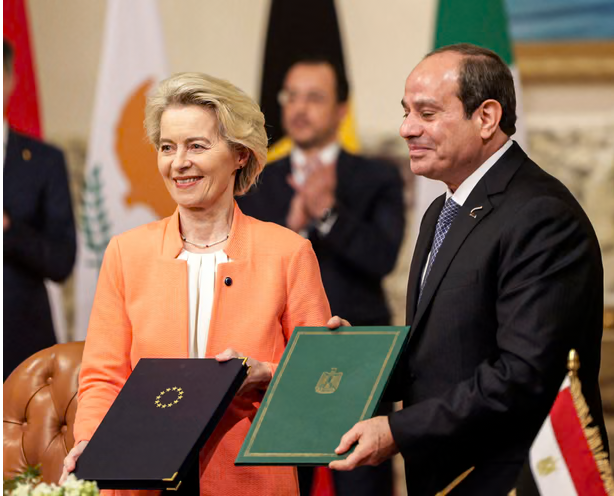
Ursula von der Leyen and Abdel Fatah al-Sisi after a meeting in Cairo in March 2024. Photograph: Stavros Ioannides/PIO/AFP/Getty Images
News Desk : The European Commission has been accused of sugarcoating figures to enable it to release funds to Egypt under a landmark pact with the authoritarian government of Abdel Fatah al-Sisi.
The charge relates to a €7.4bn deal promised by Ursula von der Leyen, the European Commission president, to al-Sisi on a high-profile visit to Cairo in 2024. The three-year “strategic and comprehensive partnership” was intended to bolster Egypt’s shaky economy, deter migrants from coming to Europe and shore up a region reeling from the 7 October attacks and Israel’s war on Gaza.
The disclosure raises broader questions about the EU-Egypt relationship, as Egyptian authorities face scrutiny over shrinking press freedom following the jailing and alleged torture of six journalists, the entire newsroom of Matsadaash, a factchecking and investigative platform, and the closure last month of one of the country’s last independent news outlets and conviction of its high-profile editor, Lina Attalah.
Attalah is appealing against that conviction and will be in court this week as she seeks to overturn other charges including “publishing false news”, for which she was sentenced to a year in prison in absentia without her knowledge.
The spotlight is on €5bn in EU “soft” loans to Egypt – lending with easy repayment terms, known as macro-financial assistance, that is meant to be available only to countries that respect human rights and democracy. While the EU conditions on democracy and rights are vague, the loans impose much more specific requirements on Egypt to carry out economic reforms.
Separate data sources – from leaked EU documents and deleted from an Egyptian government website – raise questions about the European Commission’s claims that Egypt met targets linked to social welfare programmes, which enabled the EU to release €2.5bn in assistance.
In confidential documents, the commission told EU lawmakers that Egypt had “broadly fulfilled” and then “fulfilled” two separate targets to increase the numbers of poor people on social welfare programmes between 2024 and 2026. But data points to a net reduction of 85,734 households as the Egyptian government removed people from its welfare programmes rather than expanded coverage.
If Egypt had expanded the programmes in line with the EU’s apparent conditions – and not removed any households – about 245,000 households, equivalent to roughly 909,000 people, would be getting these benefits. (The Guardian used World Bank data to make this rough calculation).
According to the leaked documents, the commission wanted Egypt to “further expand cash transfer programmes”, but despite a net reduction in beneficiaries it gave the green light anyway to two separate “soft” loans totalling €2.5bn.
In response to the Guardian’s findings, one of the European parliament’s leading spokespeople on EU-Egypt relations, the Dutch MEP Tineke Strik, said she was introducing a question to the European Commission demanding clarification.
“The finding by this investigation that the commission is seemingly sugarcoating Egypt’s performance is worrying,” Strik said. “From the beginning, the commission has used macro-financial assistance primarily as a tool to lure Egypt into migration cooperation, while considering formal conditions and its reporting obligations towards parliament as an inconvenient formality.”
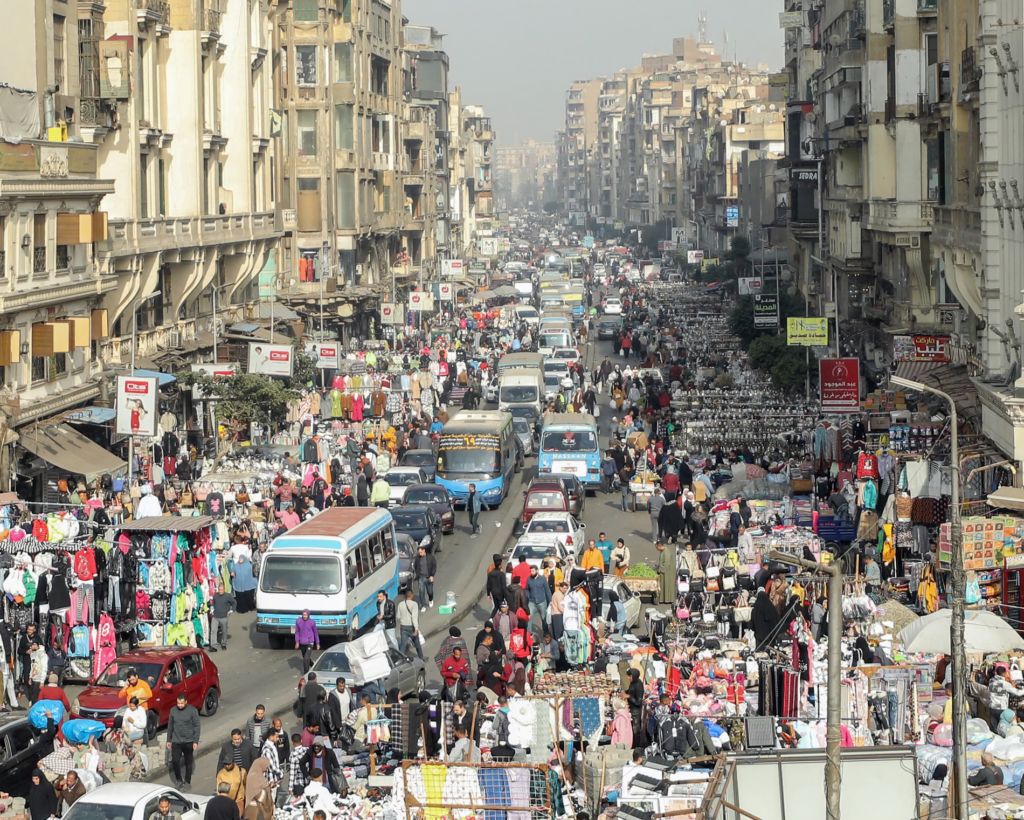
Under the plan, Egypt has so far received €3.5bn in soft loans in three instalments, with a final payment of €1.5bn expected before the end of 2027.
The charge of sugarcoating figures relates to two social welfare programmes: the Takaful and Karama cash transfer programmes for poor and vulnerable households.
The Takaful (Solidarity) programme gives poor families cash payments as long as recipients have regular health visits and good attendance at school. The Karama (Dignity) programme gives unconditional cash payments to people living with a disability, older people, orphans and widows.
One of the EU conditions for Egypt to gain the first €1bn loan was to increase the number of Takaful and Karama beneficiary households by 100,000 to 4.7 million.
In a leaked report to lawmakers in the EU council of ministers and the European parliament, the commission described that requirement as “broadly fulfilled”.
The data in that report, however, reveals a net fall of 62,281 households during this period, owing to what the EU officials describe as “a multi-annual recertification process”. Some beneficiaries were added to the list but a larger number were removed because they were deemed ineligible.
In order to achieve a later instalment of €1.5bn, Egypt was required to “further expand” the programmes, adding 60,000 households to the Takaful and Karama beneficiaries list. A second leaked report to EU lawmakers shows that the commission concluded the target was “fulfilled” because 442,118 families were added to the list.
On this occasion, the commission did not report on numbers removed. Figures from Egypt’s ministry of social solidarity, however, show a net reduction of 23,453 beneficiaries to the programmes in the 11 months until June 2026, the period leading up to the release of that payment. The EU announced the release of the €1.5bn payment in July 2026.
About the Author