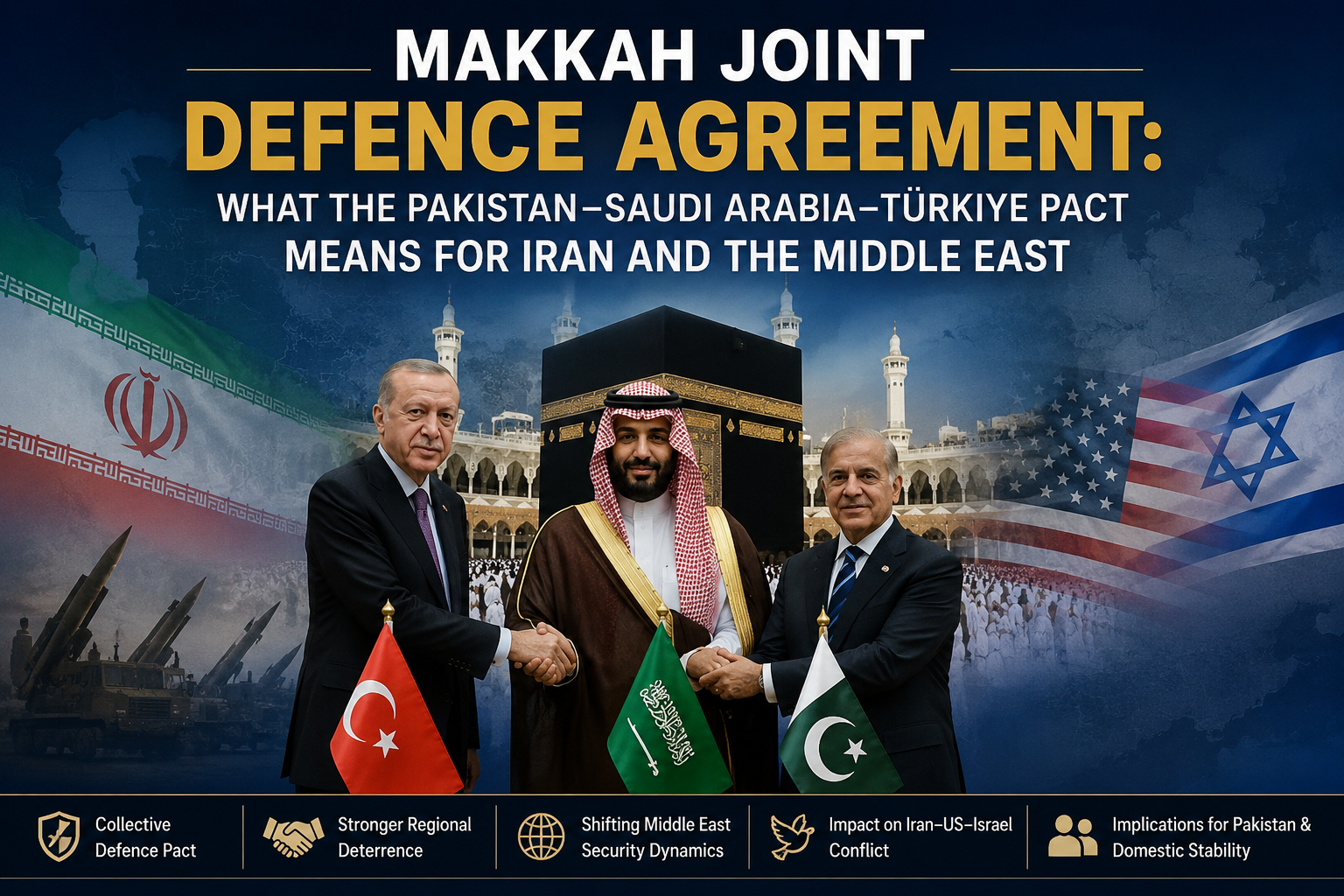
Pakistan, Saudi Arabia and Türkiye’s Makkah Joint Defence Agreement signals a new phase in regional security, raising critical questions about Iran, the US–Israel conflict, Gulf strategic autonomy and Pakistan’s own geopolitical balancing.
The Makkah Joint Defence Agreement links Pakistan, Saudi Arabia and Türkiye as Iran, Israel and US power reshape security across the Middle East.
By Aamir Hussaini
Eastern Times News Press
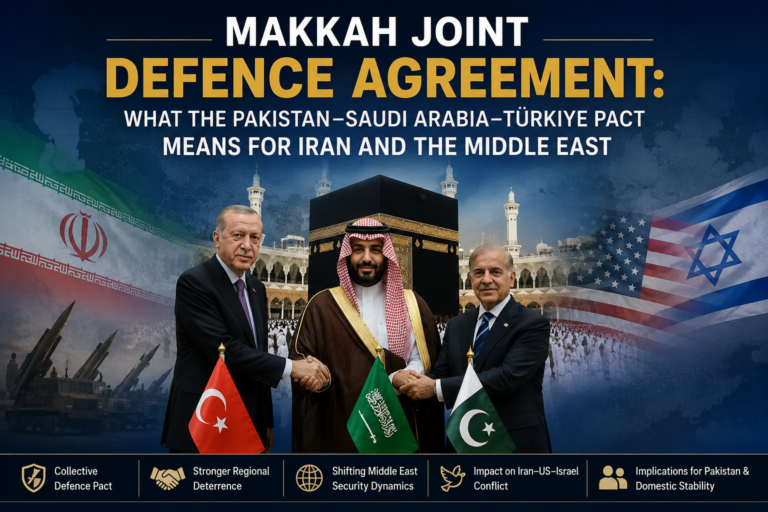
The Makkah Joint Defence Agreement has brought Pakistan, Saudi Arabia and Türkiye into a collective-defence framework at a moment when the Iran conflict is redrawing the Middle East’s security map. But the pact raises harder questions: is it aimed at deterring Iran and Israel, supplementing US protection, or laying the foundations of a new regional security order?
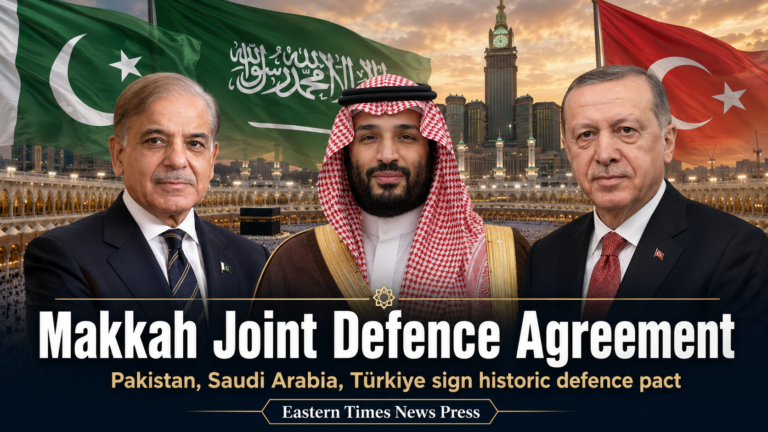
When Saudi Crown Prince Mohammed bin Salman, Turkish President Recep Tayyip Erdoğan and Pakistani Prime Minister Shehbaz Sharif met at Al-Safa Palace in Makkah on August 7, they signed an agreement whose central sentence is deceptively simple: an armed attack against any one of the three countries will be regarded as an attack against them all.
The official joint statement published by the Saudi Press Agency says the Makkah Joint Defence Agreement is intended to strengthen collective deterrence against aggression and enhance “all aspects” of defence cooperation among Saudi Arabia, Türkiye and Pakistan. Türkiye’s own official Directorate of Communications published the same collective-defence language.
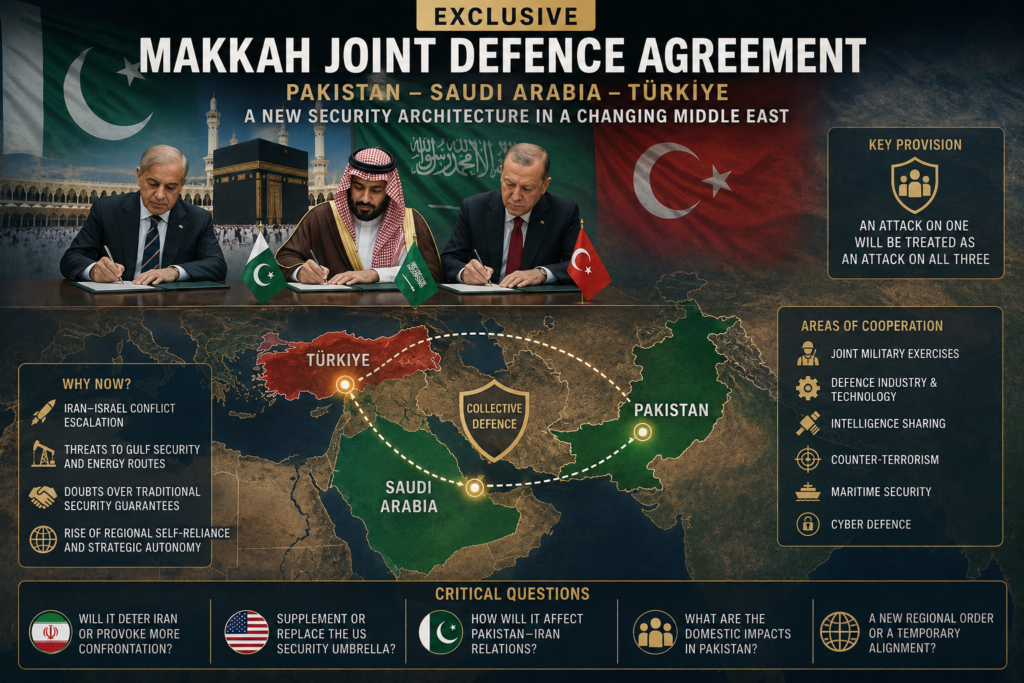
Yet the political weight of that sentence is considerably clearer than its military meaning.
The publicly released text does not specify what military response each country must provide, whether assistance would be automatic, what body would determine that an armed attack had occurred, whether attacks by proxies would trigger the pact, or whether the arrangement includes an integrated command structure comparable to NATO. Reuters noted precisely this gap: the statement does not spell out the commitments accepted by the three governments or how far they are legally bound to undertake particular military actions on one another’s behalf.
That ambiguity is not a minor technical detail. It is the key to understanding what happened in Makkah.
The agreement may eventually produce a new regional military architecture. For the moment, however, it is simultaneously a defence commitment, a deterrence signal and a declaration that three influential states no longer want their security interests to depend entirely on arrangements constructed elsewhere.
Three Countries, Three Different Calculations
To call the agreement simply a military alliance between three Sunni-majority states explains remarkably little. Saudi Arabia, Türkiye and Pakistan arrived in Makkah carrying different security anxieties, different relationships with Washington and Tehran, and different expectations from the pact.
Their interests overlap, but they are not identical.
Saudi Arabia: Security Without Exclusive Dependence
For Riyadh, the timing could hardly be more significant.
The agreement was signed while the Gulf was facing the consequences of the expanding US–Israel–Iran conflict. Iranian attacks and threats against Gulf infrastructure, attacks by Iran-aligned forces, disruption of regional energy routes and fears surrounding the Strait of Hormuz have placed Saudi economic infrastructure and the kingdom’s ambitious development plans under direct strategic pressure. Reuters reported immediately before the summit that Saudi officials feared attacks from Iran-aligned Iraqi militias in the north and the Houthis in Yemen in the south.
For decades, the foundation of Gulf security rested heavily on American military power. The US-Saudi security relationship itself stretches back to the early postwar period; American military assistance, training and defence sales became deeply embedded in Saudi security planning. Historical US government records trace the formal security-assistance relationship at least to the 1951 Mutual Defense Assistance Agreement.
The Makkah pact therefore raises an obvious question: is Saudi Arabia beginning to replace the American security umbrella?
The available evidence suggests that replacement is too strong a word.
Saudi officials have taken pains to say the agreement does not come at the expense of the kingdom’s existing Gulf, Arab or international partnerships. Rayed Krimly, Saudi deputy minister for public diplomacy, rejected descriptions of the agreement as an attempt to create either a military axis or a sectarian or religious bloc. He said it was about building sustainable, self-reliant capabilities rather than entering a nuclear arms race.
The more persuasive interpretation, at least for now, is security diversification.
Saudi Arabia is not necessarily turning away from Washington. It is reducing the dangers of having only one indispensable security guarantor. Pakistan offers manpower, military experience and longstanding institutional ties; Türkiye provides sophisticated defence manufacturing, drones, missiles, naval capabilities and NATO-standard military experience; Saudi Arabia supplies capital, strategic geography and political weight.
Reuters reports that Riyadh has also promoted a multinational maritime security initiative to protect shipping and energy routes, supported by countries including Pakistan and Türkiye. That wider effort reinforces the impression that Saudi policy is moving toward layered regional security rather than simple substitution of one patron for another.
The historical change may therefore be subtler than a “post-American Middle East”.
It may be the end of American exclusivity rather than the end of American power.
Türkiye: NATO Membership Meets Strategic Autonomy
Türkiye presents a different puzzle.
Why would the country with NATO’s second-largest military need another collective-defence mechanism?
President Erdoğan has portrayed the Makkah agreement as a defensive arrangement grounded in collective deterrence and the right of self-defence recognised by Article 51 of the United Nations Charter. He has said it targets no particular state, can deepen defence-industrial cooperation and is potentially open to other friendly countries seeking regional stability. A Turkish official also told AP that the pact does not cancel or replace Türkiye’s existing bilateral or multilateral commitments.
This matters because Ankara increasingly operates through overlapping circles of strategic engagement.
Türkiye remains structurally embedded in NATO, yet it has spent years trying to increase its room for autonomous action in the Middle East, the Caucasus, eastern Mediterranean and wider Islamic world. The Makkah agreement offers Ankara something NATO cannot automatically provide: an institutional platform connecting Turkish military technology directly with Gulf capital and Pakistani military capabilities.
Its defence industry could be one of the agreement’s most concrete beneficiaries.
Saudi Arabia is already a significant purchaser of Turkish drones, while Türkiye and Pakistan have longstanding programmes involving naval cooperation, aircraft, training and defence production. Reuters described the three militaries as bringing complementary capabilities into the framework.
The agreement therefore need not be interpreted as Türkiye choosing between NATO and Makkah.
It may instead represent Erdoğan’s preferred model of strategic autonomy through multiple memberships.
And that immediately complicates the assumption that the pact belongs automatically inside a US-led anti-Iran bloc.
Türkiye has its own disputes with Iran, but it also has powerful reasons to prevent Iran’s collapse, avoid uncontrolled regional war and preserve economic and diplomatic channels with Tehran. Ankara’s increasingly antagonistic relationship with Israel further complicates any attempt to classify the three-state pact as an extension of an American-Israeli strategy. AP noted that Turkish-Israeli relations have deteriorated sharply around Gaza and other regional wars.
Pakistan: Strategic Influence at a Strategic Price
Pakistan may be the agreement’s most consequential—and most exposed—member.
Islamabad has maintained defence relations with Saudi Arabia for decades. Those relations were formalised further on September 17, 2025, when Mohammed bin Salman and Shehbaz Sharif signed the Strategic Mutual Defense Agreement, stating that aggression against either country would be considered aggression against both. The official Pakistan Foreign Ministry joint statement on the 2025 agreement explicitly described it as an instrument of joint deterrence.
The Makkah agreement now extends that logic to Türkiye.
Pakistan contributes something neither of the other two countries can reproduce exactly: a large professional military with decades of operational experience, deep familiarity with Saudi forces, a mature defence industry and nuclear weapons.
The last point requires particular caution.
Nothing in the publicly released Makkah agreement establishes a Pakistani nuclear umbrella over Saudi Arabia or Türkiye. Reuters notes that Pakistan previously played down such interpretations of its bilateral Saudi pact, saying nuclear weapons were “not on the radar”, while Saudi officials have now explicitly rejected attempts to link the trilateral agreement with nuclear ambitions or an arms race.
Nuclear capability gives Pakistan strategic status. It does not automatically convert every defence agreement it signs into a nuclear guarantee.
More tangible is Pakistan’s conventional role. Reuters reports that Pakistan has deployed thousands of military personnel along with fighter aircraft, drones and air-defence capabilities to Saudi Arabia amid the regional crisis. Pakistan has also provided training and technical assistance to Saudi forces for decades.
But precisely because Pakistan is now more deeply embedded in Saudi security, Islamabad faces a question Riyadh and Ankara do not:
What happens if the country from which Saudi Arabia seeks protection is Iran?
Iran: The Unnamed Fourth Actor?
The temptation to describe the Makkah agreement simply as an anti-Iran pact is understandable. It is also analytically dangerous.
The immediate strategic environment undeniably revolves around Iran.
The United States and Israel launched military attacks on Iran on February 28, 2026, after which the conflict expanded across the region. Iran and Iran-aligned forces subsequently attacked or threatened Gulf targets and energy infrastructure. Saudi Arabia has experienced the consequences directly.
An Iranian parliamentarian, Ebrahim Rezaei of parliament’s National Security and Foreign Policy Commission, reacted critically to the Makkah agreement, arguing that Saudi Arabia would not obtain security merely through agreements with Pakistan and Türkiye. But another Iranian analyst quoted by AP, former politician Abdolreza Davari, dismissed the idea that the three-country pact dramatically altered Iran’s strategic position.
That divergence is revealing.
Iran itself may not have a single interpretation of the agreement.
Saudi Arabia says the pact is not sectarian. Türkiye says it targets no country. Pakistan continues to advocate diplomacy with Tehran. At the same time, all three have legitimate concerns about Iranian missiles, drones, proxies and the spillover from the US-Iran war.
Reuters quoted RUSI researcher Burcu Ozcelik describing the emerging objective as building deterrence against Iranian predominance while also balancing Israeli military power, rather than preparing for war with Tehran.
That may be the more useful frame.
The agreement can be designed to deter Iran without being institutionally anti-Iranian.
Equally important, it can seek to constrain Israeli military dominance without becoming an anti-Israel alliance.
Middle Eastern alignments are increasingly too contradictory for the old vocabulary of two permanent camps.
The Iran–US–Israel Triangle Changes Everything
The most revealing sentence in Reuters’ reporting on the agreement may be one easily overlooked: Pakistan, Türkiye and Saudi Arabia share concerns about increasingly assertive military behaviour by both Iran and Israel.
That observation makes it difficult to describe the agreement as merely another layer of the American-led regional order.
Saudi Arabia remains closely linked to Washington but has avoided formal diplomatic normalisation with Israel. Türkiye is a NATO member but has become one of Israel’s sharp regional critics. Pakistan does not recognise Israel and has simultaneously maintained close Saudi ties and working relations with Tehran.
The agreement therefore occupies an unusual geopolitical space.
Washington may welcome partners assuming more responsibility for regional defence. Yet an autonomous Saudi-Turkish-Pakistani security structure could also reduce the United States’ ability to determine how regional crises are managed.
Israel may welcome greater deterrence against Iran, yet could hardly assume that a stronger Türkiye-led regional defence capacity would automatically serve Israeli strategic preferences.
Iran may perceive elements of containment, yet Saudi Arabia’s simultaneous push for diplomacy and Pakistan’s mediation suggest the pact cannot be reduced to preparation for an Iranian war.
The emerging order is less a chessboard of two camps than a network of states cooperating with each other on one issue and competing on the next.
Pakistan Between Riyadh and Tehran
For Pakistan, this ambiguity is existentially important.
Islamabad cannot treat Iran as a distant Middle Eastern power. The countries share a long border and security problems extending through Balochistan. Their relationship also touches trade, energy, cross-border militancy and regional connectivity.
Pakistan has historically tried to avoid becoming a frontline state in Saudi-Iranian competition. In 2015, when Riyadh sought Pakistani military participation in the Yemen war, Pakistan’s parliament called for neutrality while simultaneously pledging support for Saudi territorial integrity.
A US Institute of Peace analysis later described Pakistan’s policy as a decades-long attempt to maintain exceptionally close Saudi ties without appearing openly anti-Iranian.
That balancing act has continued dramatically in 2026.
Pakistan condemned the February attacks on Iran but also condemned Iranian attacks on Saudi Arabia, Bahrain, Jordan, Kuwait, Qatar and the UAE. The Pakistan Foreign Ministry’s February 28 statement called for restraint and a diplomatic solution rather than choosing one side’s military narrative.
Islamabad subsequently played a formal mediating role between Iran and the United States. The Foreign Ministry’s record of the Islamabad Memorandum process confirms that Pakistan and Qatar served as mediators in follow-up US-Iran discussions.
This produces the central contradiction of Pakistani strategy.
Pakistan is simultaneously trying to become a more credible security partner for Saudi Arabia and a more credible diplomatic interlocutor for Iran.
Both roles can coexist as long as the Makkah agreement remains principally deterrent.
A direct Saudi-Iranian confrontation would make that balance much harder.
Would Pakistan restrict itself to defending Saudi airspace? Would attacks by Houthis or Iraqi militias count as Iranian aggression? Would Islamabad participate in offensive operations against Iranian territory? Would parliament have a role? Could Pakistan refuse one form of military assistance while providing another?
The published agreement answers none of these questions.
They may ultimately matter more than the ceremony in Makkah.
Could Pakistan’s Shia Citizens Pay a Domestic Price?
The most sensitive Pakistani question lies not outside its borders but within them.
Could membership in a Saudi-centred defence architecture increase insecurity for Pakistani Shias?
There is currently no evidence that the Makkah agreement itself has produced a new wave of anti-Shia violence in Pakistan, and it would be irresponsible to predict such an outcome as inevitable.
Saudi Arabia has explicitly rejected the label of a sectarian or religious bloc. Pakistan has not defined Iran as an enemy. Türkiye’s interests in the agreement are predominantly strategic rather than sectarian.
But risk cannot be assessed only by reading official intentions.
Pakistan has a long and documented history in which external geopolitical competition has interacted with internal sectarian identities. Scholarship on Pakistani sectarianism traces the radicalisation of Sunni-Shia politics through domestic changes surrounding General Zia-ul-Haq’s Islamisation policies, the Iranian Revolution, the Afghan war and the subsequent rise of organised sectarian movements.
More recent scholarship cautions against reducing the Saudi-Iran rivalry simply to an ancient Sunni-Shia conflict. A 2025 study in Politics and Religion found that religion and geopolitical power politics coexist and that both Riyadh and Tehran have used religious identities instrumentally according to changing strategic circumstances.
That distinction is essential in Pakistan.
Pakistani Shias are Pakistani citizens, not an extension of the Iranian state. To treat their religious identity as evidence of geopolitical allegiance would itself reproduce the logic that has historically made minorities vulnerable.
The danger therefore does not necessarily come from the agreement’s legal text. It lies in how political entrepreneurs, militant organisations, clerics and social-media networks might narrate it.
If the agreement begins to be popularly described as a “Sunni alliance against Shia Iran”, that rhetoric could reactivate an old and dangerous vocabulary inside Pakistan. If Iran-linked political actors respond by framing Pakistani foreign policy in explicitly sectarian terms, the polarisation could work in both directions.
That is why journalists and policymakers should monitor measurable indicators rather than simply speculate: anti-Shia hate speech, sectarian mobilisation, militant propaganda, threats against religious gatherings, social-media narratives and official rhetoric.
There is also important counter-evidence.
A Reuters investigation published on August 6 reported that a Pakistani state crackdown on hardline Islamist organisations has substantially reduced registered blasphemy cases and some forms of religiously motivated mob violence this year. Reuters reported that Christian, Shia and Ahmadi communities had experienced tangible improvements in security, although minority representatives remained cautious about whether the change would endure.
At the same time, broader structural vulnerabilities remain. Human Rights Watch’s 2026 Pakistan assessment continues to describe religious minorities as exposed to discriminatory laws, mob violence and failures of accountability.
The relevant question is therefore not whether the Makkah pact will create Sunni-Shia violence.
It is whether Pakistani institutions are strong enough to prevent an international security alignment from being translated into domestic sectarian identity politics.
Why “Muslim NATO” and “Sunni NATO” Both Mislead
The expressions are irresistible headlines.
They are also analytically weak.
NATO has an elaborate institutional architecture: permanent political bodies, military commands, integrated planning, interoperability standards and decades of jointly developed doctrine. The Makkah agreement, based on what has been published, has none of that yet.
Nor does “Sunni NATO” adequately describe the politics of its members.
Türkiye and Saudi Arabia were serious regional competitors only a few years ago. Pakistan has resisted becoming a combatant in Saudi-Iranian wars. Saudi Arabia restored diplomatic channels with Iran before the current conflict. Türkiye simultaneously competes and cooperates with Tehran.
Even the Saudi government has publicly rejected the sectarian-bloc interpretation.
The more meaningful phrase may be regional security architecture.
Abdulaziz Sager of the Gulf Research Center told Reuters that closer coordination among the three countries could increase their collective diplomatic and defence weight while contributing to a more regionally driven security order.
That does not make a new NATO inevitable.
It tells us something more important: governments that previously depended heavily on outside powers are increasingly asking what security capabilities they can construct among themselves.
What Will Determine Whether Makkah Changes the Region?
The real test begins after the signatures.
If the three states develop common military planning, integrated air and missile defence, intelligence-sharing mechanisms, joint commands, standing exercises, weapons-development programmes and agreed procedures for responding to aggression, Makkah could eventually become the foundation of a substantial new defence institution.
If implementation remains limited to consultation, defence sales, exercises and political solidarity, it may function more like a strategic insurance policy.
AP cited Middle East analyst Hamish Kinnear as arguing that large Pakistani or Turkish troop deployments are unlikely and that deeper coordination in defence production, diplomacy and technology transfer may prove more realistic.
That distinction matters.
The agreement’s greatest immediate power may lie not in what armies it moves tomorrow but in what calculations it forces adversaries and allies to make today.
Iran must now calculate whether pressure on Saudi Arabia could bring Pakistani and Turkish capabilities more directly into the equation.
Israel must consider whether the emerging regional system is designed solely around Iran—or could eventually constrain Israeli freedom of action as well.
Washington must decide whether greater regional self-reliance is desirable burden-sharing or the beginning of a security order over which the United States exercises less control.
Türkiye must reconcile new regional obligations with NATO.
Saudi Arabia must decide how far autonomy from American dependence should go.
And Pakistan faces perhaps the most difficult question of all: whether it can simultaneously remain Saudi Arabia’s treaty-bound security partner, Iran’s neighbour and interlocutor, China’s strategic partner and a state responsible for preventing external geopolitical rivalries from hardening sectarian divisions among its own citizens.
The Makkah Joint Defence Agreement has therefore not yet created a new Middle Eastern order.
But it may reveal the direction in which that order is moving.
The old regional system was built around relatively fixed alignments: American protection, Iranian resistance, Arab dependence and external military power. The emerging system looks different. States increasingly hedge, overlap and diversify. NATO members enter non-NATO security frameworks; US partners negotiate with America’s enemies; Saudi Arabia seeks protection from Pakistan and Türkiye while retaining Washington; and Pakistan joins a collective-defence arrangement while mediating between Tehran and the United States.
Makkah’s significance may ultimately lie there.
The pact tells the world that Riyadh, Ankara and Islamabad want their security futures to become more closely connected. What it does not yet tell us is how much each government is prepared to sacrifice when the security of one member collides with the strategic interests of another.
The first genuine crisis of the agreement—not its signing ceremony—will answer that question.
About the Author