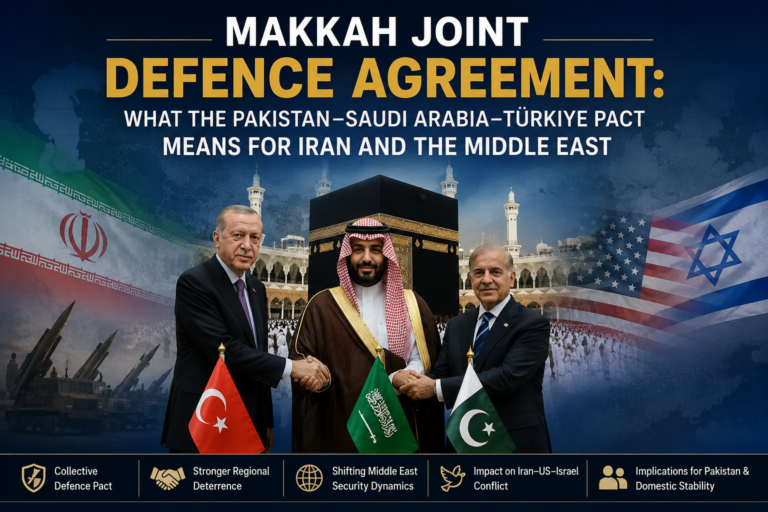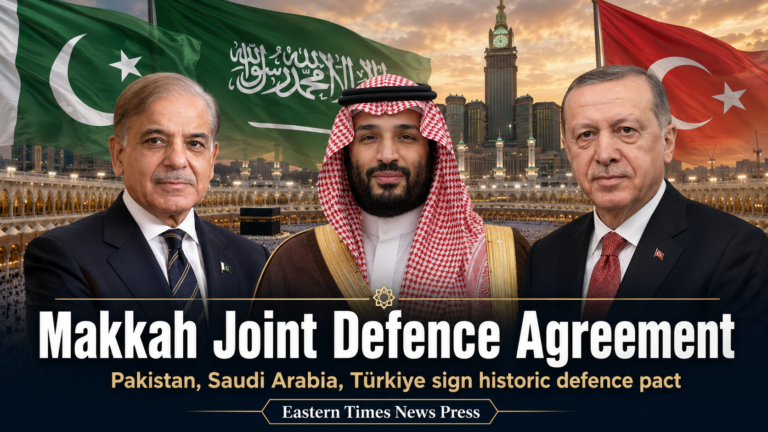
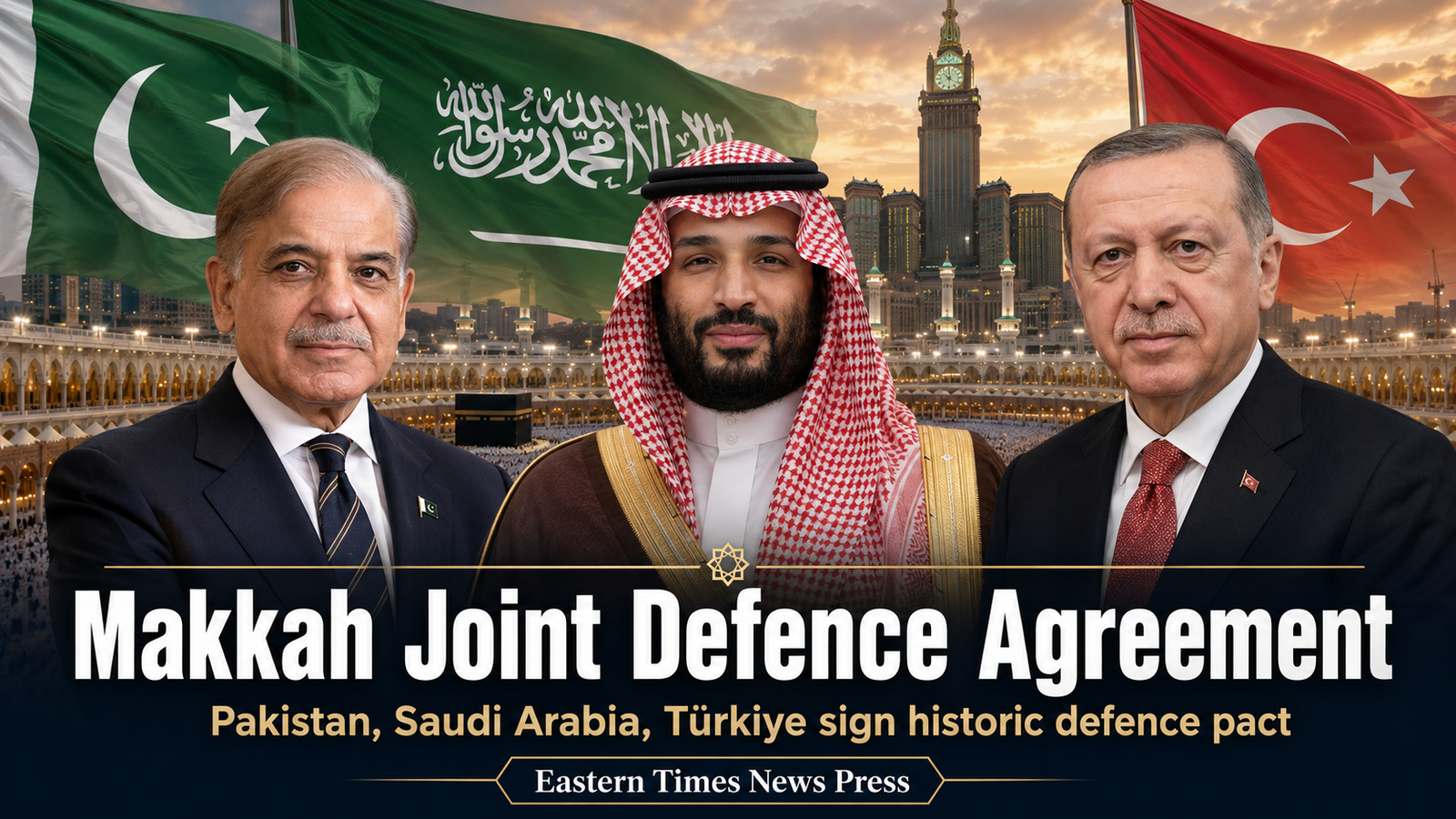
Pakistan Prime Minister Shehbaz Sharif, Saudi Crown Prince Mohammed bin Salman and Turkish President Recep Tayyip Erdoğan featured in an Eastern Times News Press graphic on the Makkah Joint Defence Agreement signed on August 7, 2026.
Pakistan, Saudi Arabia and Türkiye sign the Makkah Joint Defence Agreement, pledging collective defence and expanded military cooperation.
MAKKAH — Eastern Times News Press | August 8, 2026
Sources: International, Pakistani, Saudi and Turkish news agencies and official sources
Pakistan, Saudi Arabia and Türkiye signed the Makkah Joint Defence Agreement in Makkah on August 7, establishing a collective-defence framework under which an armed attack on one member will be regarded as an attack on all three.
Pakistan, Saudi Arabia and Türkiye have formally entered a new trilateral security framework after their leaders signed the Makkah Joint Defence Agreement at Al-Safa Palace in Makkah on Friday, August 7, in a move that could significantly reshape defence cooperation linking South Asia, the Gulf and Türkiye.
The agreement was signed by Pakistani Prime Minister Muhammad Shehbaz Sharif, Saudi Crown Prince and Prime Minister Mohammed bin Salman, and Turkish President Recep Tayyip Erdoğan during the Makkah Al-Mukarramah Summit for Joint Defence. The signing and the central provisions of the pact were confirmed in an official joint statement published by the Saudi Press Agency and subsequently reported by Pakistani, Turkish, Saudi and international news organisations.
Attack on One to Be Treated as Attack on All
At the heart of the Makkah Joint Defence Agreement is a collective-defence commitment. The official statement says the accord is designed to strengthen deterrence against aggression and provides that an armed attack against any one of the three states will be regarded as an attack against all three.
The provision gives the pact its greatest strategic significance. It extends the principle of mutual defence beyond the bilateral Pakistan-Saudi security arrangement established in 2025 and creates a three-state framework involving one of the Gulf’s most influential powers, South Asia’s only nuclear-armed state and NATO member Türkiye.
However, the publicly released statement does not specify the exact military obligations, force commitments or response mechanisms that would follow an attack. Reuters noted that it remains unclear how far the agreement legally or operationally binds each state to take a particular form of military action on behalf of another. The pact should therefore not be interpreted as providing an automatic NATO-style military response unless further implementation documents establish such a mechanism. Reuters’ report on the Makkah defence agreement
What the Makkah Joint Defence Agreement Covers
Beyond collective deterrence, the three countries have agreed to expand defence cooperation more broadly. The official Saudi statement describes the agreement as an extension of longstanding defence ties and shared strategic interests among the three states, while Saudi and Turkish officials have indicated that the framework can support closer military coordination and capability-building.
President Erdoğan said the pact would strengthen security and defence cooperation, facilitate joint defence-industry projects and deepen cooperation against terrorism. He also linked the agreement’s collective-security principle to the right of self-defence recognised under Article 51 of the United Nations Charter.
Saudi Defence Minister Prince Khalid bin Salman described the agreement as providing a framework for a long-term defence partnership aimed at improving deterrence, coordination and integration among the three countries. Saudi Deputy Minister for Public Diplomacy Rayed Krimly likewise said the pact was the culmination of negotiations conducted over a number of years and was intended to enhance military readiness and collective defence capabilities. Arab News coverage of the agreement and Saudi statements
Saudi Arabia Says Pact Is Not a Military or Sectarian Bloc
Saudi officials have been careful to push back against interpretations portraying the agreement as the formal creation of a new ideological military alliance.
Krimly said the pact should not be viewed as an attempt to establish either a military axis or a sectarian bloc, nor should it be connected automatically to a nuclear arms race. He also said the new arrangement does not replace the three countries’ existing bilateral or multilateral commitments and is not intended as a threat to another state.
Saudi Foreign Minister Prince Faisal bin Farhan said the agreement reflected the depth of the three countries’ strategic relationships and their desire to coordinate more closely in dealing with threats and challenges affecting regional security.
That clarification is particularly important because the agreement was signed amid acute Middle Eastern tensions. The public text itself does not identify Iran, Israel, India or any other state as an adversary.
Erdoğan Says Agreement Is Open to Other Friendly Countries
President Erdoğan also rejected the suggestion that the new defence arrangement had been created to target a particular country. He said it remained open to other friendly nations seeking peace, security and prosperity in the region.
Türkiye would continue to favour dialogue, diplomacy and international law in resolving regional conflicts, Erdoğan said. Turkish authorities have separately stressed that participation in the Makkah agreement does not contradict Türkiye’s existing international obligations, including its membership of NATO.
This distinction could become crucial in assessing how the new trilateral framework develops. Türkiye remains a major NATO military power, while the Makkah accord creates an additional security mechanism with partners outside the Atlantic alliance rather than formally replacing Ankara’s existing treaty obligations.
Pakistan Builds on 2025 Saudi Defence Pact
For Pakistan, the Makkah agreement represents an expansion of a defence architecture already strengthened through its bilateral relationship with Saudi Arabia.
On September 17, 2025, Prime Minister Shehbaz Sharif and Crown Prince Mohammed bin Salman signed the Pakistan-Saudi Strategic Mutual Defence Agreement in Riyadh. That agreement also established the principle that aggression against either country would be considered aggression against both. Associated Press of Pakistan report on the 2025 Strategic Mutual Defence Agreement
The new Makkah pact effectively brings Türkiye into a broader version of that collective-security concept while building on decades of separate Pakistani defence relationships with both Ankara and Riyadh.
Prime Minister Sharif called the agreement a historic development and said he hoped it would serve as a “shield of peace” for future generations. He described Pakistan, Saudi Arabia and Türkiye as three states linked by longstanding friendship and a shared commitment to regional peace and security. Anadolu Agency report on Prime Minister Sharif’s statement
Why the Agreement Matters for Middle East and South Asia
The timing gives the agreement additional geopolitical weight. The pact has emerged during a period of severe instability in the Middle East, with conflict involving the United States, Israel and Iran spilling into Gulf security and threatening energy infrastructure and maritime trade routes.
Reuters reported that Saudi Arabia and other Gulf states have faced Iranian missile and drone attacks during the wider regional conflict, while Riyadh has also faced threats from Iran-aligned armed groups. The new agreement therefore comes at a moment when Gulf governments are reassessing how regional states can contribute more directly to their own security.
The three signatories also bring substantially different capabilities to the framework. Türkiye possesses NATO’s second-largest military and an increasingly important defence-manufacturing sector; Pakistan has a large, experienced military establishment and longstanding defence-training relationships across the Gulf; Saudi Arabia combines major financial resources, strategic energy importance and growing defence ambitions.
Their convergence consequently creates a potentially significant security bridge between South Asia, the Arabian Peninsula and the eastern Mediterranean.
A New Regional Security Architecture — But Not Yet a “Muslim NATO”
The agreement has already prompted comparisons with NATO and speculation about the emergence of a new security bloc in the Muslim world. Such descriptions currently go beyond the published treaty language.
Abdulaziz Sager, chairman of the Saudi-based Gulf Research Center, told Reuters that the framework could strengthen the collective diplomatic and defence influence of the three states and contribute to the emergence of a more regionally driven security architecture.
That assessment captures perhaps the most important longer-term question raised by the pact. Whether the Makkah Joint Defence Agreement evolves into an institutionalised alliance will depend on what follows the signing: command arrangements, joint exercises, intelligence structures, defence-industrial cooperation, contingency planning and the possible accession of additional countries.
For now, what is confirmed is more precise. Pakistan, Saudi Arabia and Türkiye have established a formal trilateral collective-defence framework; an armed attack against one is to be treated as an attack against all three; defence cooperation is to be expanded; and the agreement is being presented by its signatories as defensive rather than directed against a named adversary.
What remains unanswered is exactly how those commitments would be implemented in an actual military crisis. That distinction will ultimately determine whether the Makkah agreement becomes primarily a powerful political signal of solidarity or the foundation of a substantially new regional defence architecture.
About the Author