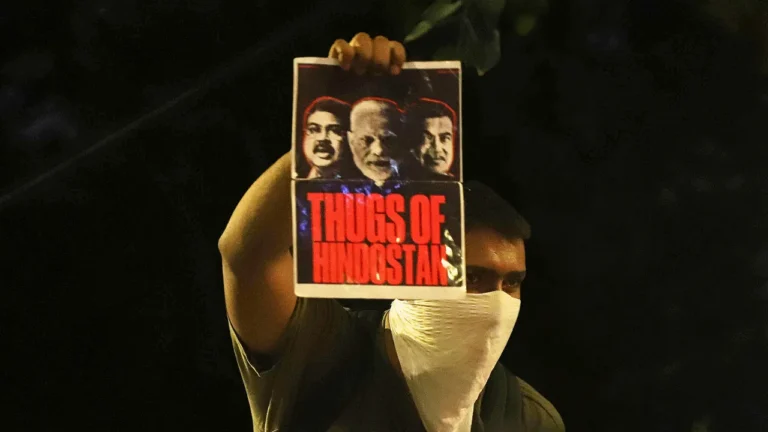
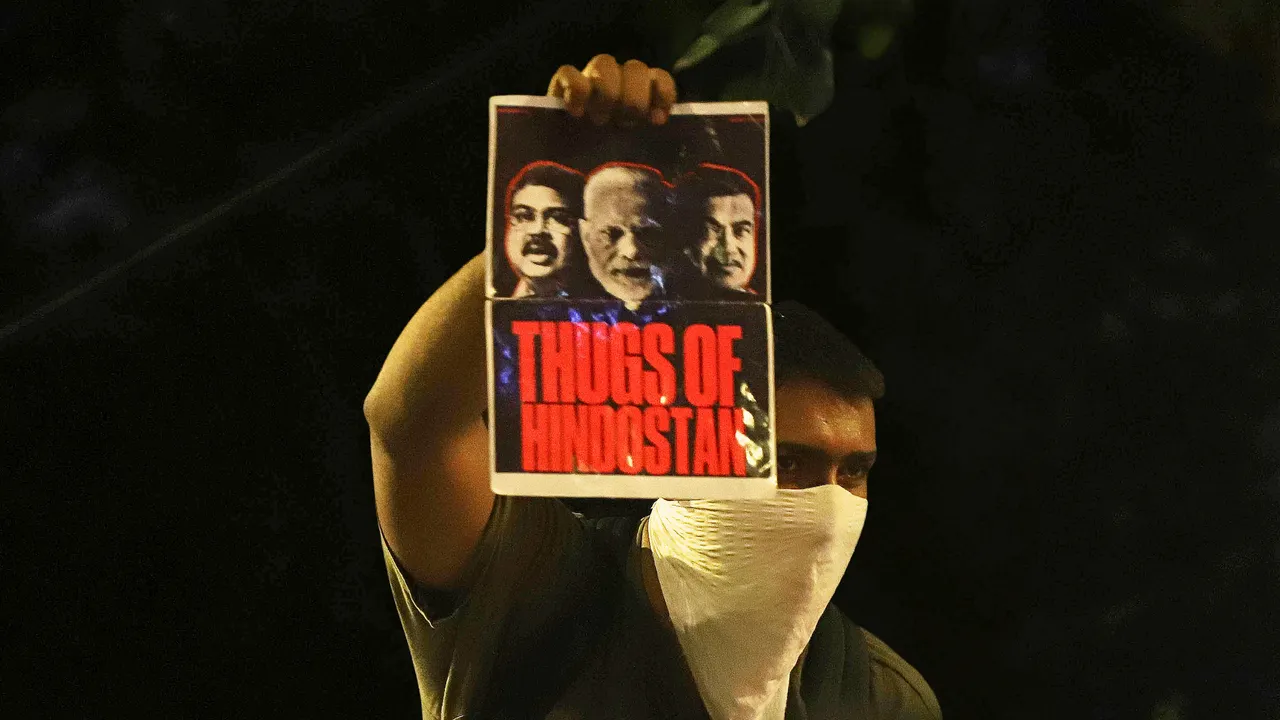
An insult intended to establish distance between an exalted institution and the people outside its gates instead supplied those people with a name. India’s young protesters took the cockroach—an image of infestation, worthlessness and exterminability—and turned it into a political emblem. They drew it on placards, animated it in reels, placed it beside the national flag and attached it to a satirical organisation whose initials echoed those of Narendra Modi’s Bharatiya Janata Party. What had been spoken as contempt returned as collective authorship.
This reversal is the animating force of Neha Dixit’s article for Himal Southasian, “How the CJP protests have shaken Modi’s stranglehold over India.” Published on 25 July 2026, the article follows the transformation of anger over the cancellation of the National Eligibility cum Entrance Test into a broader movement against unemployment, administrative impunity, police repression and Hindu majoritarian rule. Its central claim is not simply that the Cockroach Janta Party mobilised large crowds. It is that a generation raised under the political discipline of the Modi era has started losing its fear.
That claim deserves serious attention. The National Testing Agency’s public notices confirm that the NEET examination held on 3 May 2026 was replaced by a nationwide re-examination on 21 June, accompanied by a refund process for the cancelled sitting. Later reporting established that approximately two million candidates were affected, while a federal investigation produced allegations involving individuals connected to the testing agency, coaching institutions and the circulation of leaked questions. The protests were therefore not built around an invented grievance or a routine administrative error. They arose from an institutional betrayal affecting millions of families.
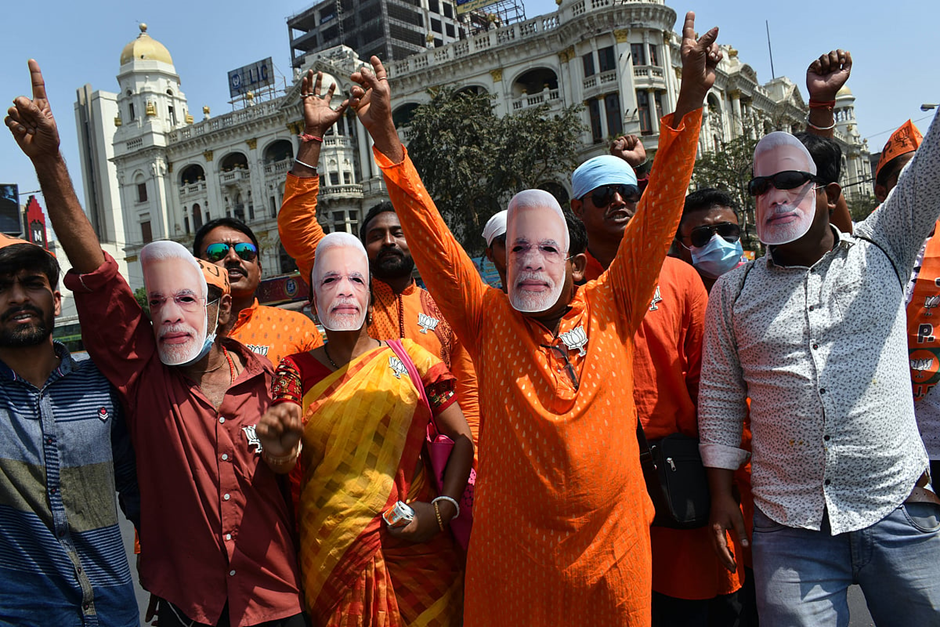
Dixit’s achievement is to show how such a technical failure became a crisis of political legitimacy. Her article moves between the intimate despair of examination candidates, the humour of digital rebellion and the longer history of state action against journalists, students, Muslims, farmers, Adivasis, Kashmiris and civil-liberties activists. Yet the very narrative force that makes the article compelling also causes it to move too rapidly across unresolved facts and political contradictions. It captures the emotional truth of the rebellion more convincingly than it maps the institutions, interests and exclusions within it.
What Dixit’s Article Captures
Dixit begins not with a minister or movement celebrity but with Pragya Gautam, a young Dalit medical aspirant who travelled overnight to Delhi with little money and without informing her parents. This is an effective journalistic decision. The examination scandal is immediately removed from the sterile language of “irregularities” and placed within the life of a young woman whose education, economic independence and freedom from an unwanted marriage have become dependent on a test administered by institutions she cannot hold accountable.
The opening also establishes the connection between caste, gender and aspiration without turning it into an abstract sociology lesson. Gautam’s predicament embodies a basic truth: competitive examinations are not equally important to everyone. For a student with inherited wealth, private professional networks or access to foreign education, a cancelled examination may be an inconvenience. For a Dalit, lower-caste, rural or lower-middle-class aspirant, it can destroy one of the few imaginable routes out of economic insecurity and social subordination.
Dixit is equally persuasive when she describes the cultural intelligence of the movement. Earlier Indian protests developed their own songs, slogans, kitchens, libraries, murals and constitutional symbolism. The CJP added the expressive grammar of digital-native life: memes, gaming metaphors, dance reels, protest-date jokes, detention selfies, online food diaries, mock tutorials and public ridicule of politicians who had long been presented as figures of unquestionable authority.
This humour should not be dismissed as adolescent theatre. Authoritarian power relies partly on spectacle. It demands that the ruler appear disciplined, omniscient, masculine and historically indispensable. Ridicule breaks the spell by making the ruler appear awkward, ageing, vain or simply ordinary. The young protesters’ mocking response to Modi’s Instagram intervention demonstrated that political communication can no longer be controlled merely through televised speeches, carefully managed interviews and party amplification networks. Reuters’ profile of CJP founder Abhijeet Dipke documents how the movement combined satire, social-media reach and physical protest to create a national political presence.
Dixit also understands that the movement did not appear from nowhere. Her reconstruction passes through the award-return campaign, the repression at Jawaharlal Nehru University, Rohith Vemula’s death, Bhima Koregaon, Kashmir after the removal of Article 370, Shaheen Bagh, the anti-Citizenship Amendment Act demonstrations and the farmers’ encampments around Delhi. This is essential. The CJP inherited a repertoire of resistance produced through earlier struggles: community kitchens, volunteer medical care, constitutional imagery, interfaith solidarity, protest art and the refusal to leave public space.
The article is strongest when it treats the movement as accumulated anger rather than a miracle of generational awakening. Examination leaks provided the ignition, but the combustible material had been gathering through unemployment, educational debt, caste exclusion, stagnant incomes, unaffordable coaching, insecure gig work and the growing visibility of elite privilege.
From Examination Fraud to a Crisis of the Republic
India’s competitive examinations operate as a mass promise of meritocracy. They tell students that wealth, caste, geography and family connections can be overcome through study. The promise has always been imperfect, but it retains enormous power because the alternatives are even more unequal. Corporate recruitment often favours English-language education, metropolitan institutions, social networks and cultural familiarity. Government examinations at least present themselves as anonymous, standardised and rule-bound.
A paper leak therefore does more than compromise a test. It reveals that the supposedly neutral gateway may itself be privately purchasable. The student who studied for years discovers that another candidate may have obtained the paper through money or connections. The state has not merely failed to detect cheating; it has allowed the social privileges that the examination was supposed to suspend to re-enter the examination hall.
The scale is structural. An India Today investigation into examination leaks documented at least 65 major incidents between 2019 and mid-2024, affecting recruitment examinations, universities, school boards and national entrance tests across 19 states. The investigation found that examinations connected to more than 300,000 government posts had been cancelled and described operations involving transport chains, contractors and organised leak networks. More recent Reuters reporting on the 2026 crisis connected the NEET scandal to a broader breakdown of trust in India’s examination and employment systems.
Here Dixit does not go far enough. Her article identifies the repeated leaks but does not investigate the examination industry. Who designs the papers? Who translates them? Which private technology companies process registrations and results? How are examination centres contracted? Who transports sealed materials? Which firms receive repeat tenders after security failures? How do coaching centres, middlemen, officials and political patrons interact?
Without those questions, “government accountability” risks becoming a moral demand detached from the administrative machinery that requires reform. Dharmendra Pradhan’s resignation was an important political victory, subsequently confirmed in national and international reporting. But the departure of one minister does not dismantle the commercial and bureaucratic networks that turn examinations into opportunities for extraction.
The employment statistics also demand greater precision than the article provides. The Indian government’s Periodic Labour Force Survey data for 2025 placed unemployment among people aged 15 to 29 at 9.9 percent, down from 10.3 percent in 2024. The government presents this as evidence of improvement. Other research has shown much higher unemployment among educated young people, especially graduates. These figures are not necessarily contradictory: they measure different populations, periods and forms of work. A graduate delivering food for an app may count as employed while remaining trapped in insecure, low-paid labour unrelated to their education.
A more rigorous article would have distinguished unemployment from underemployment, insecure employment and the absence of permanent salaried work. It would also have examined the state’s counterargument rather than simply treating one statistic as self-evident proof. That would not weaken the critique. It would reveal how headline employment numbers can coexist with profound insecurity.
The social anger is intensified by inequality. The World Inequality Lab’s study of income and wealth inequality in India found that the richest one percent received 22.6 percent of national income and controlled 40.1 percent of wealth by 2022–23. A later inequality report estimated that the richest ten percent received approximately 58 percent of national income. This is the economic landscape in which families sacrifice consumption, borrow money and send children to distant coaching centres in the hope of obtaining a secure position.
Memes, Reels and the Politics of Ridicule
Dixit is right to argue that the CJP’s digital vocabulary altered the relationship between protest and political authority. Gen Z protesters did not wait for television studios to recognise them. They circulated their own footage, mocked hostile anchors and converted police action into a stream of counter-propaganda.
Yet virality should not be confused with organisation. A social-media follower is not necessarily a movement member, voter, volunteer or participant. Algorithms can create sudden visibility and equally sudden disappearance. Platforms reward outrage, novelty and emotional intensity; they do not reward patient institution-building, internal debate or policy design.
The movement’s own digital presentation describes Dipke as its founding president and offers forms of online affiliation. These details do not discredit the movement, but they raise questions that Dixit leaves untouched. Who owns membership data? Who controls passwords, donations and public statements? What procedures allow participants to select or remove leaders? How are movement resources distributed? What safeguards prevent a satirical collective from becoming the personal brand of its founder?
The movement was also less spontaneous than its digital mythology suggests. Dipke had experience in political communication before launching the CJP. AISA activists supplied disciplined organisational labour and undertook prolonged hunger strikes. Sonam Wangchuk brought national recognition and the moral authority of his Ladakh campaign. Opposition parties, trade unions, lawyers, doctors and civil-society networks supplied additional infrastructure. Reuters’ account of Dipke’s political development is especially useful for understanding the experience behind the supposedly spontaneous digital eruption.
Dixit mentions many of these actors but still frames the movement primarily as the eruption of a generation. That language can erase organisers while pretending to celebrate spontaneity. Every apparently leaderless movement contains people who control microphones, social accounts, negotiations, legal funds and access to journalists. Democratic scrutiny should begin inside movements, not only when they enter government.
What the Article Leaves Unexamined
The most significant missing perspective is that of Muslims who were sympathetic to the protests but uncertain about the movement’s politics. Dixit describes interfaith solidarity and sympathy for Kashmir and Manipur. But a later Scroll investigation into Muslim responses to the CJP found that some young Muslims stayed away because movement leaders avoided questions of communal violence, political prisoners and anti-Muslim persecution.
A CJP spokesperson described this avoidance as a conscious decision to keep the movement focused on education. Some Muslim participants accepted the tactical calculation. Others argued that a movement presenting itself as a democratic challenge to the Modi government could not marginalise the people who had borne some of the harshest consequences of majoritarian rule.
This complication matters because Dixit makes the struggle against Hindutva central to her interpretation. If the movement suspends the question of Hindutva’s primary targets in order to remain broadly acceptable, its solidarity is not yet as complete as the article suggests. A movement may reject Hindu-Muslim polarisation while still refusing to confront the institutional production of Islamophobia.
The treatment of Kashmir is similarly insufficient. Dixit rightly situates the protests within the history of internet shutdowns and repression in Kashmir. But Kashmiris remain objects of solidarity rather than speaking political subjects in her narrative. When allegations emerged that pellet weapons had been used against protesters in Delhi, the connection to the long history of pellet injuries in Kashmir required more than a passing reference. Police denials, medical accounts and subsequent judicial proceedings needed to be carefully separated rather than compressed into a single narrative of established fact.
The article also reports that women and queer participants considered the protest site safe. Such testimony is valuable, but safety should be investigated rather than proclaimed. Were there complaint mechanisms, women marshals, legal-support teams, accessible toilets, secure sleeping arrangements and protections against harassment? Who decided which slogans were allowed? Were queer and trans participants represented in decision-making? Cultural openness at a protest site does not automatically abolish the hierarchies present in the wider society.
The judicial origin story requires an even clearer qualification. Dixit presents Chief Justice Surya Kant’s remarks as a general description of unemployed young people who become journalists, activists or social-media critics. The language was widely reported and understood in precisely that way, and it undeniably became the movement’s catalyst. However, the Chief Justice later said that the word “cockroaches” referred to people holding fake law degrees rather than Indian youth generally. His clarification was subsequently reiterated and reported by The Indian Express.
That clarification does not erase the political impact or excuse dehumanising judicial speech. It does mean that careful journalism must distinguish between what was said in court, how it was initially reported, how protesters understood it and how the judge later contextualised it. Dixit’s article does not adequately preserve these distinctions.
There are smaller editorial problems too. The article says that Neha Bora’s mother returned home on 20 June, although the surrounding chronology places the episode in July. It cites a social-media following that other reports placed much higher, suggesting either a rapidly changing figure or inadequate date-stamping. It presents disputed casualty and injury numbers without consistently showing which came from organisers, hospitals or police.
These are not fatal flaws, but they matter in a story whose moral power depends on exposing institutional misinformation. Journalism challenging government propaganda must be unusually disciplined about its own chronology and attribution.
Beyond the Romance of a Leaderless Revolt
The CJP is simultaneously a meme, a political brand, a protest coalition and an emerging organisation. Its ambiguity helped it grow. People could join without accepting a complete ideology. A medical aspirant, an Ambedkarite, a communist student organiser, a gig worker, a liberal constitutionalist and a disenchanted former BJP supporter could all recognise themselves in the demand for accountability.
The same ambiguity could become a weakness. A movement can postpone ideological conflict while confronting a common opponent; it cannot postpone it indefinitely. It will eventually have to decide whether it is a pressure group, a registered party, a student organisation, an electoral platform or a temporary coalition.
It must also define what examination reform means. An independent audit of the National Testing Agency? Public disclosure of contractors? Stronger whistle-blower protection? Compensation for affected candidates? Limits on examination fees? Regulation of coaching centres? Independent appointments to testing bodies? Time-bound investigations and trials? Protection against punitive cases for peaceful protesters?
A ministerial resignation provides a visible victory, but institutional demands determine whether a movement changes history or merely changes personnel. Reuters’ reporting on the negotiations between protest leaders and the government shows that the demands extended beyond Pradhan’s resignation to the withdrawal of police cases and compensation for affected families.
The South Asian comparisons in Dixit’s article also require restraint. Youth-led movements in Bangladesh, Nepal, Sri Lanka and elsewhere may share digital styles, anti-corruption demands and distrust of inherited political elites. They do not constitute a single Gen Z ideology. Their relationships with established parties, militaries, religious movements, labour organisations and constitutional systems differ sharply. The political aftermath of removing a government can be more difficult than the uprising itself.
Has Fear Really Been Broken?
The most memorable claim in Dixit’s article is that fear has started to leave Indian public life. There is evidence for this. Tens of thousands defied restrictions in Delhi. Protesters returned to Jantar Mantar after police action. Mainstream media organisations that initially ignored or attacked the movement were forced to cover it. The Guardian’s report from the Delhi protest documented the return of protesters after the crackdown and the growing national visibility of their demands.
Modi addressed the crisis, and Pradhan resigned shortly afterwards—a rare concession from a government whose political image depends heavily on refusing public pressure. By 1 August, Modi was publicly arguing that prosecution alone would not resolve the student crisis.
But fear is not defeated merely because people act despite it. After the agreement, the CJP accused authorities in several states of arresting, detaining or harassing participants. The movement threatened to resume demonstrations, while the government disputed the claim that all participants had been promised immunity. The Guardian’s follow-up investigation documented these accusations and the continuing struggle over police cases.
The more accurate conclusion is that fear has been fractured. The movement demonstrated that the Modi government can be mocked, pressured and forced into a concession. It did not establish that the surveillance system, police machinery, prosecutorial power or majoritarian political bloc sustaining the government has been dismantled.
Dixit’s article is therefore best read as a report from an opening rather than a declaration of liberation. Its urgency, historical memory and closeness to the protest site make it an important piece of political journalism. Its weaknesses arise from the same proximity: the movement’s hope sometimes becomes the article’s organising assumption.
The Cockroach Janta Party will become historically consequential only if it can transform digital recognition into democratic organisation, examination anger into institutional reform, and symbolic solidarity into accountable alliances with workers, farmers, Dalits, Adivasis, Muslims, Kashmiris, women, queer communities and insecure labourers. It must also prove that its leaders will accept from their own supporters the transparency they demand from the state.
The cockroach was an effective symbol because it suggested something power could not entirely destroy. But endurance is not the same as transformation. Survival becomes politics only when it creates institutions, redistributes power and leaves people with more than a memorable name.
About the Author