Part 2
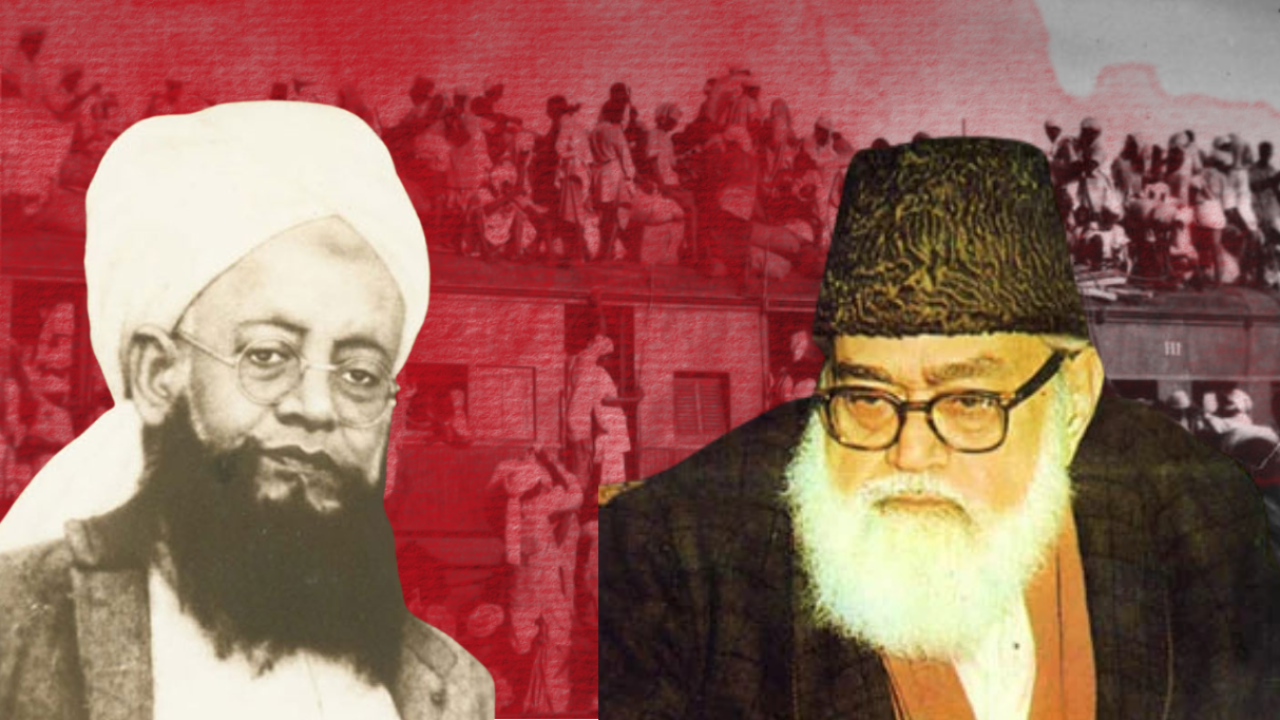
Jinnah vs Maududi: The forgotten Muslim debate over Pakistan
- Altaf Parvez Examines the 1947 Pakistan Debate: Altaf Parvez explores how Islamist parties, especially Maududi’s Jamaat-e-Islami, positioned themselves during the creation of Pakistan and their ideological opposition to Jinnah and the Muslim League.
- Maududi’s Critique of Jinnah and the Muslim League: Maududi viewed Jinnah’s Muslim League as a ‘Jamaat-e-Jahiliyat’ (pre-Islamic community) and criticized their nationalism, proposing instead an Islamic revolutionary ideology.
- Opposition to the Concept of Pakistan as a Secular State: Maududi opposed the idea of a democratic Pakistan based on Western principles, advocating for an Islamic government governed by the sovereignty of Allah, viewing nationalism as incompatible with Islamic teachings.
- Maududi’s Theological Arguments Against Nationalism and Democracy: He regarded nationalist ideas and democracy as Western inventions that conflicted with Islamic principles, emphasizing the need for a government based on divine sovereignty.
- Maududi’s Shift on the Pakistan Movement and Electoral Participation: Initially opposed to Pakistan and democratic elections, Maududi later changed his stance to participate in the referendum on joining Pakistan, based on his ideological emphasis on Islamic governance.

In the wake of Bangladesh’s mass uprising of 2024, the partition of India in 1947 has re-emerged as a subject of renewed political and historical interest. A range of narratives has surfaced that seeks to frame the 2024 uprising not in continuity with the popular movements of 1971 or 1990, but instead by drawing parallels with the political moment of 1947. Some of these voices go further, presenting the events of 1947 and 2024 as part of a shared historical trajectory and claiming joint authorship of both moments.
Against this backdrop, the noted researcher Altaf Parvez turns to the past to interrogate how Islamist parties positioned themselves during the creation of Pakistan in 1947. Today, the second article in this series is being published on the ideological debate between M. A. Jinnah and Maulana Maududi during the Partition of India.
Maulana Maududi used to describe Jinnah’s Muslim League as Jamaat-e-Jahiliyat
In the previous article, I outlined M. A. Jinnah’s arguments in favour of dividing the Indian subcontinent to create a separate state for Muslims. The concept of the two-nation theory was also explained there in a concise manner.
Set against the ‘Muslim nationalist’ position of Jinnah and the Muslim League, the article also discussed the views of Maulana Madani and Jamiat-e-Ulama-e-Hind—the leading group of anti-imperialist Islamic scholars who advocated an undivided Indian nationalism.
At the same time, Jinnah and the League faced strong ideological opposition from Maulana Syed Abul A‘la Maududi as well. Soon after the Lahore Resolution, Maududi founded Jamaat-e-Islami in 1941. As a result, what initially appeared as a theoretical disagreement gradually turned into an organisational confrontation. Maududi led the party for 31 years (1941–1972).
During the struggle for the creation of ‘Pakistan’, three distinct strands of opposition emerged from Maulana Maududi and his party towards the Muslim League.
First, criticism of Jinnah himself; second, opposition to the demand for Pakistan as a separate state; and third, resistance to the organisational culture of the Muslim League. Complementing these were two further positions: opposition to the anti-British independence movement itself, and opposition to Jamiat-e-Ulama-e-Hind, the Deobandi-influenced organisation of clerics that participated in that movement. In contrast to all this, Jamaat-e-Islami and its founder argued for the necessity of an ‘Islamic revolution’.
Maududi was reluctant to accept the idea of a future ‘democratic Pakistan’ because, in his view, democracy placed popular sovereignty above the sovereignty of the Creator. He also regarded it as a ‘Western concept’.

Maududi was similarly critical of nationalism. Portraying nationalism as a ‘European idea’, he argued that under this framework a citizen of one state could not be loyal to another. In Islam, by contrast, belief in Allah alone constitutes the criterion for membership. The two, therefore, were fundamentally incompatible. In his view, if someone claimed to be both a nationalist and obedient to Islam, it revealed a flaw in their thinking. Maududi made these arguments with both camps in mind—Jinnah and the League on one side, and Madani and the Jamiat on the other.
At this time, Maududi also opposed the conference held under the banner of the All-India Azad Muslim Conference, an umbrella platform of major Muslim organisations advocating independence. While these groups demanded freedom from British rule, they also opposed the partition of India. Participants included the Jamiat, Ahrar, Momin Conference, Muslim Majlis, Ahl-e-Hadith, Shia Conference, as well as Sher-e-Bangla Fazlul Huq’s Krishak Praja Party. Leaders of the Khilafat Movement also supported this initiative. The British authorities responded sharply and negatively to the conference’s positions. Inquilab Zindabad was its principal slogan. When the Muslim League observed ‘Pakistan Day’ on April 19, 1940, the Azad Muslim Conference marked the same day as ‘Hindustan Day’. Jamaat-e-Islami also opposed these Inquilab Zindabad activists.
During the Pakistan Movement, before 1947, while forming his own party, Maududi argued that the Qur’an does not recognise the concept of a nation; instead, it speaks of factions (hizb). He made these arguments as part of his opposition to the emerging nationalist consciousness among Indian Muslims at the time.
The difference before and after the formation of Jamaat lay in the direction of his critique. Before the party was established, Maududi primarily spoke out against the Congress–Madani alliance. After 1941, however, he mainly positioned himself against the Muslim League. Until 1946, Maududi criticised the League and Jinnah in an almost continuous manner.
Four months before the Lahore Resolution was moved, Maududi wrote that from the senior-most leaders of the Muslim League to its junior ranks, no one’s mind or thinking followed an Islamic pattern. The strategies they were adopting to safeguard Muslim interests were being treated by them as Islamic politics. The real truth, he argued, was that this amounted to a denigration of Islam (Tarjuman-ul-Qur’an, November 1939, p. 79).
When this statement drew criticism from within League circles, Maududi responded the following month in his journal Tarjuman-ul-Qur’an (December 1939, p. 11), writing:
If Islam is the name of a movement, then its leaders must be those who possess a correct understanding of that movement. Without such qualities, no matter how intelligent or learned they may be, they cannot lead such a movement. Look at your leaders—look at the Qa’id-e-Millat and the Amir-e-Laskar. The whole world knows that the first gentleman (Jinnah) has no understanding of the fundamentals of Islam. The principal qualification of the second gentleman (Allama Mashriqi, leader of the Khaksar Movement) is that he has distorted the basic principles of Islam and presented something new in Islam’s name.
To Maududi, the end of British rule in India, followed by the creation of a separate state for Muslims and the establishment of a democratic society there, amounted to qaumi jamhuriyat (national democracy). He regarded national democracy as akin to replacing the idol of Manat with that of Lat in pre-Islamic Mecca (Tarjuman, May–June 1940, p. 12).
In contrast, he articulated his own objective as the establishment of Hukumat-e-Ilahiya (the sovereignty of God). He was not even prepared to accept Pakistan as an intermediate, preparatory stage on the path towards Hukumat-e-Ilahiya (Tarjuman, December 1940–January 1941, pp. 154–55).

To Maududi, the demand by Indian Muslims for one or more separate states after the British departure was a ‘minor issue’. In his assessment, what Muslims in India needed was to form an ideological party, setting aside questions of a ‘national homeland’ and ‘freedom’ (The Freedom Movement in the Subcontinent and Muslims, Vol. 2, cited earlier, p. 217).
He made these arguments immediately after the Lahore Resolution. Yet later, we see that Maududi did in fact move to Pakistan after its creation. In 1941, however, when Muslim League organisers told him that a separate Muslim state could later be transformed into an Islamic state, Maududi dismissed such claims as ‘false assurances’. In his view, such a Pakistan would establish a ‘kafir government of Muslims’ (Tarjuman, March 1941, p. 29).
From this position, his party did not participate in the 1946 elections either. Jamaat also raised objections to the electoral process itself. Officially, it was said that Jamaat would remain ‘neutral’ in the elections. Maududi went further, declaring that voting in, or becoming a member of, a parliamentary system based on democratic principles was haram (Tarjuman, December 1945, p. 52).
Despite such fatwas, Muslim society overwhelmingly went to the polling centres to vote for the Muslim League. Towards the end of British rule, it was observed that Maududi did not object to the referendum in the North-West Frontier Province on joining Pakistan. This raised the question at the time: why was Maududi changing his earlier position in the case of the NWFP referendum? In response, he said that parliamentary elections and referendums were two different kinds of electoral exercises.
From late 1939 and into early 1940, he directly accused the League of seeking merely a separate country rather than an Islamic nation-state. For demanding Muslim ka hukumat instead of Islam ki hukumat, he labelled the League Jamaat-e-Jahiliyat (Tarjuman, July 1939, p. 5).
He wrote,
Even as a Muslim, I am not interested in the establishment of Muslim rule in those parts of India where Muslims are in the majority. What matters more to me is whether the system of government in this so-called ‘Pakistan’ will be founded on the sovereignty of Allah, or whether it will operate on the Western democratic principle of popular sovereignty. If it follows the former principle, it will indeed be Pak-i-stan. Otherwise, it will be Na-paki-stan, no different from the parts of India ruled by non-Muslims. The Na-paki-stan called Pakistan that you are planning is even more impure in the sight of the Creator and more deserving of His curse, because Muslims there are doing exactly what non-Muslims do… This Muslim nationalism, like Indian nationalism, is condemnable in the light of the Creator’s Shariah. (Tarjuman, May–June 1940, p. 11)
Altaf Parvez is a researcher specialising in history. The article has been translated by Samia Huda.
About the Author