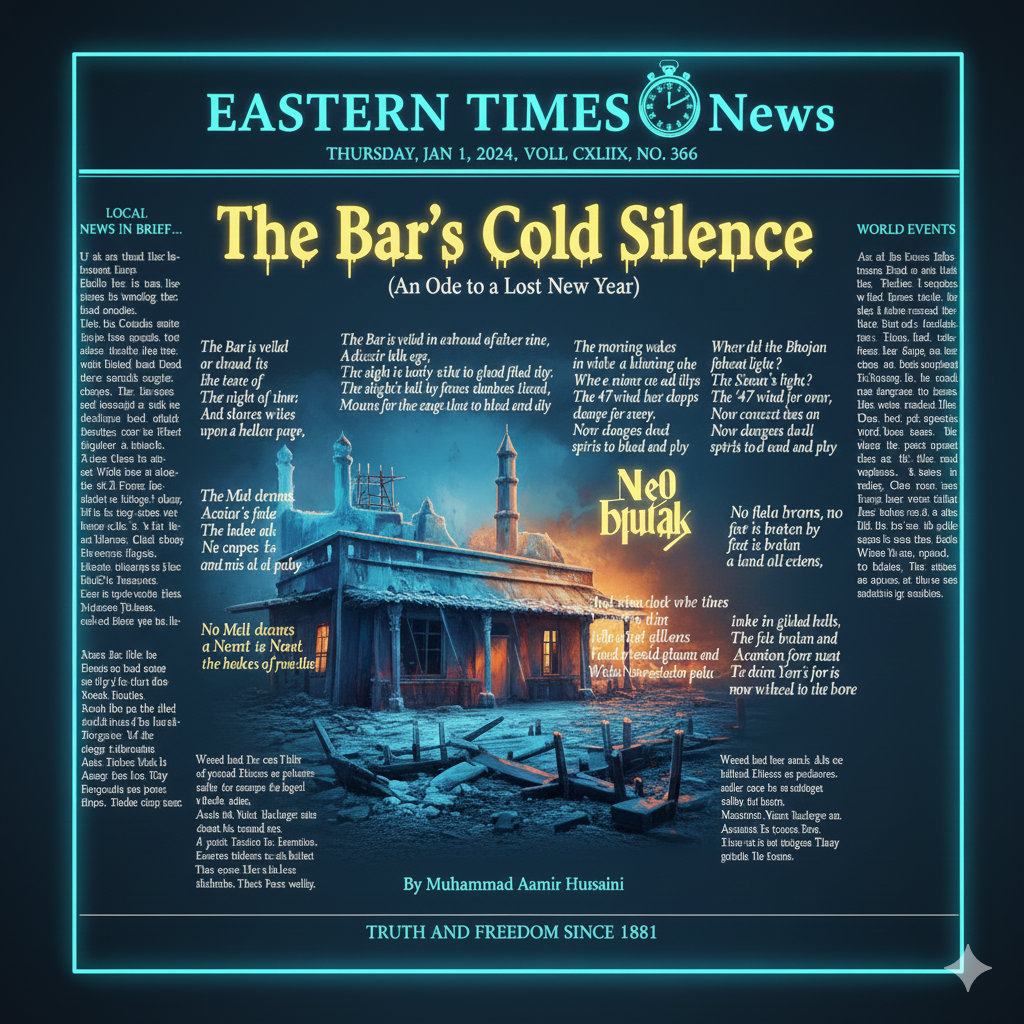
The Bar’s Cold Silence
(An Ode to a Lost New Year)
By Muhammad Aamir hussaini
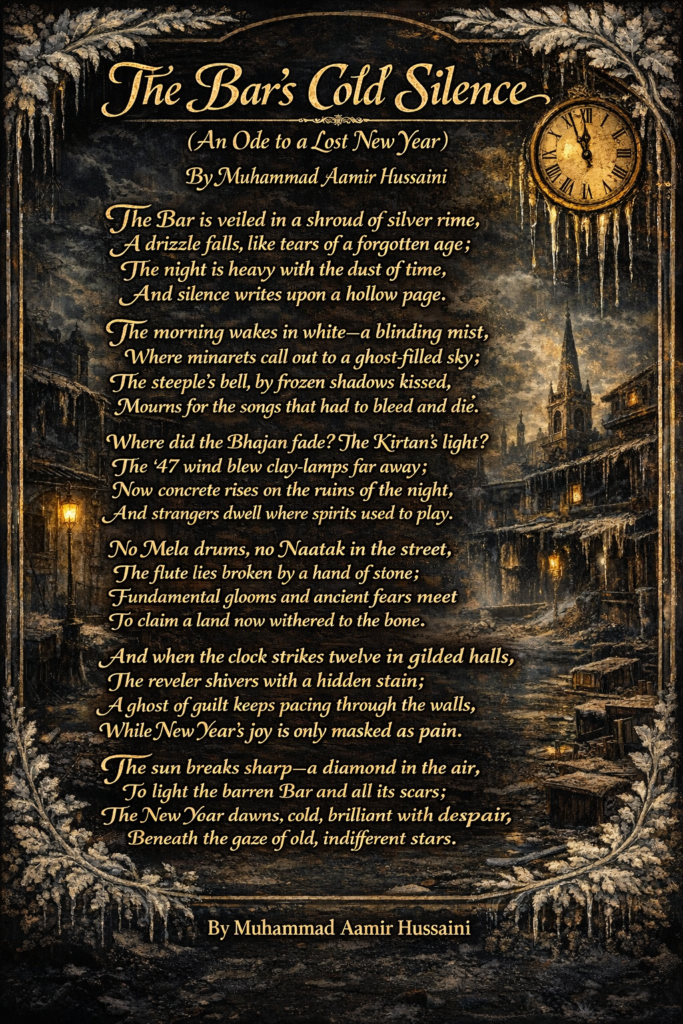
The Bar is veiled in a shroud of silver rime,
A drizzle falls, like tears of a forgotten age;
The night is heavy with the dust of time,
And silence writes upon a hollow page.
The morning wakes in white—a blinding mist,
Where minarets call out to a ghost-filled sky;
The steeple’s bell, by frozen shadows kissed,
Mourns for the songs that had to bleed and die.
Where did the Bhajjan fade? The Kirtan’s light?
The ’47 wind blew clay-lamps far away;
Now concrete rises on the ruins of the night,
And strangers dwell where spirits used to play.
No Mela drums, no Naatak in the street,
The flute lies broken by a hand of stone;
Fundamental glooms and ancient fears meet
To claim a land now withered to the bone.
And when the clock strikes twelve in gilded halls,
The reveler shivers with a hidden stain;
A ghost of guilt keeps pacing through the walls,
While New Year’s joy is only masked as pain.
The sun breaks sharp—a diamond in the air,
To light the barren Bar and all its scars;
The New Year dawns, cold, brilliant with despair,
Beneath the gaze of old, indifferent stars.
The Poet’s Monologue: Background and Intent
“As the son of refugees who fled the Ambala Division in 1947, carrying the Urdu tongue and the scars of Haryana, I stand today in the ‘Ganji Bar’ (the Seraiki belt). My perspective is not that of a conqueror or a detached observer, but of a progressive soul who recognizes that my own displacement was used as a tool in a larger, more sinister ‘Social Engineering.’
This poem was born from the realization that the New Year in this region is not a celebration, but a confrontation with silence. I wrote this to bridge the gap between Mallarmé’s symbolism and the material reality of the Seraiki people. It is a critique of the colonial and post-colonial ‘Labyrinth’—the concrete structures built over the spiritual ruins of Multani and Riasti cultures. It is an admission of the ‘Guilt’ carried by the migrant elite and the state bureaucracy who, under the guise of progress and ‘Thal Development,’ alienated the local son of the soil from his own hearth.”
Exegesis: A Stanza-by-Stanza Analysis
I. The Shroud of History
The sky, a shroud of Ganji Bar’s cold mist… While beneath the silt, the buried souls are sleeping. Exegesis: The “mist” is not just weather; it is Historical Amnesia. It represents the way the post-colonial state has clouded the true identity of the Bar. The “buried souls” are the indigenous locals and the vanished pre-partition communities whose history is being suffocated by the “silt” of new administrative borders and land allotments.
II. The Fragmented Sacred
From minarets, the lonely summon flows / To meet the steeple’s chime… But where is the Bhajjan? Exegesis: I highlight the Religious Void. While Islamic calls to prayer and church bells remain, the Bhajjan and Kirtan (the Hindu and Sikh heartbeat of the land) are gone. This is a lament for the pluralistic Punjab that died in 1947. The “frozen air” signifies the chilling of communal harmony, replaced by a rigid, singular identity.
III. The Death of the Local Stage
The theater is dead; the Mela’s drum is torn / By shadows preaching fire… Exegesis: Here, I address Cultural Fundamentalism. The “shadows” are the forces of Jihadism and Mullahism that have replaced the Naatak (folk theater) and Mela (cultural fairs) with a “righteous gloom.” The “broken flute” (Wanjhli) is the symbol of the silenced local artist, suppressed by a bourgeois-clerical alliance.
IV. The Bourgeois Guilt
The reveler drinks with eyes of secret dread; / The phantom of a sin haunts every wall… Exegesis: This is the heart of the Class Critique. In the “gilded halls” of the elite (the paaposh areas), New Year’s Eve is an artificial joy. The “phantom of a sin” is the subconscious realization that their prosperity is built on the dispossession of the Seraiki peasant. As a Marxist, I see this “dread” as the internal contradiction of the exploiter class.
V. The Indifferent New Dawn
The sun breaks through—a diamond, sharp and cold… The New Year comes… In shadows dancing on a ghost-filled street. Exegesis: The sun is “sharp and cold”—it does not warm; it merely exposes the “scars” of the Bar. The New Year is “ancient” because it repeats the same cycle of colonial exploitation. To me, the “ghost-filled street” represents the Seraiki national question: a people present in body but treated as ghosts in the census, the budget, and the history books.
Final Reflection
“I conclude that the New Year can only truly dawn when the National Question is resolved—when the local majority regains its linguistic and economic sovereignty. Until then, the ‘Pale Echo’ is all we have—a reminder that under the concrete of our modern cities lies a soul waiting to be liberated.”



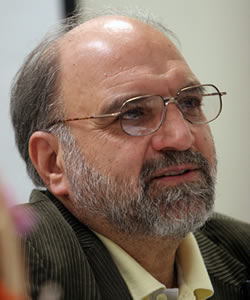
About the Author