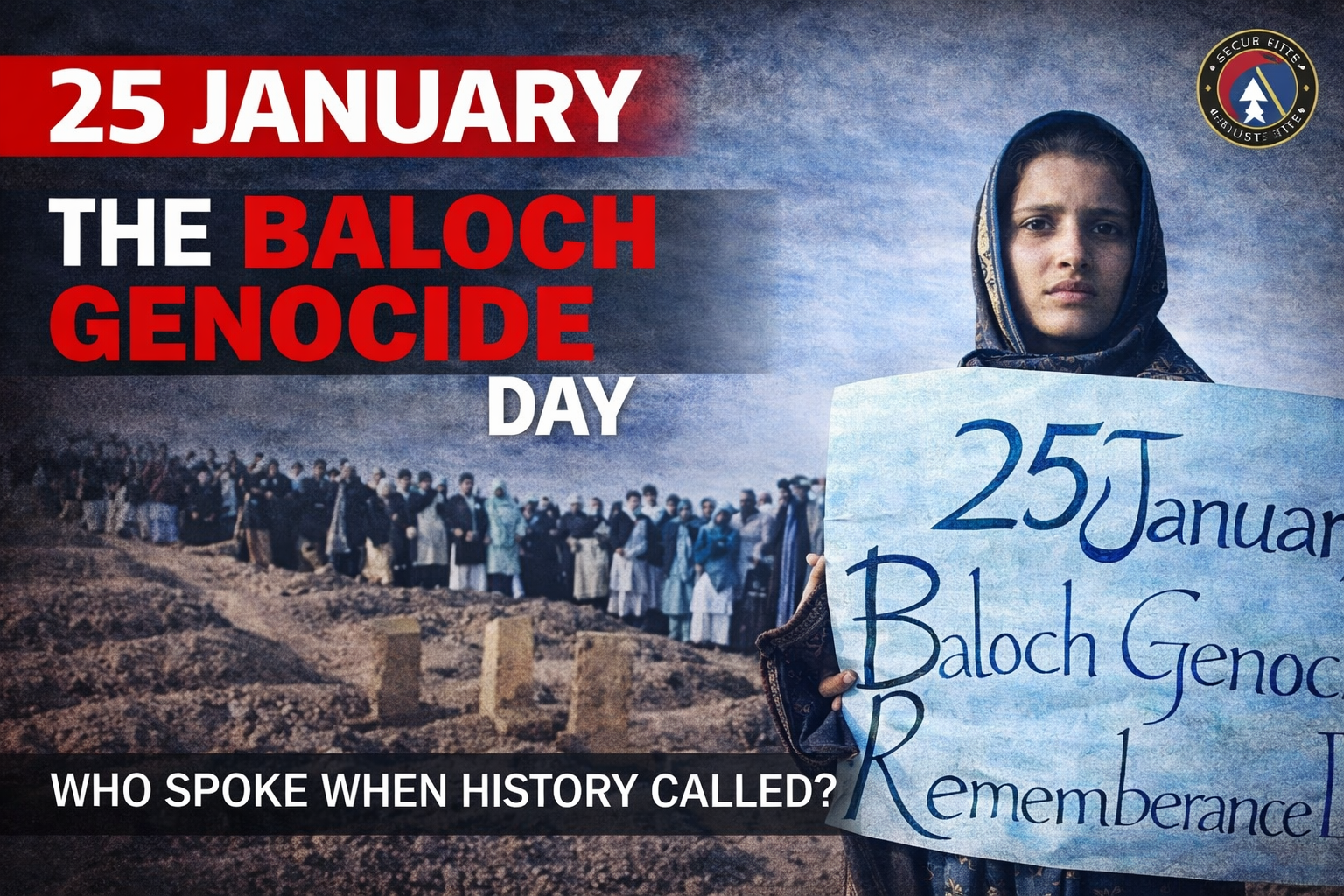
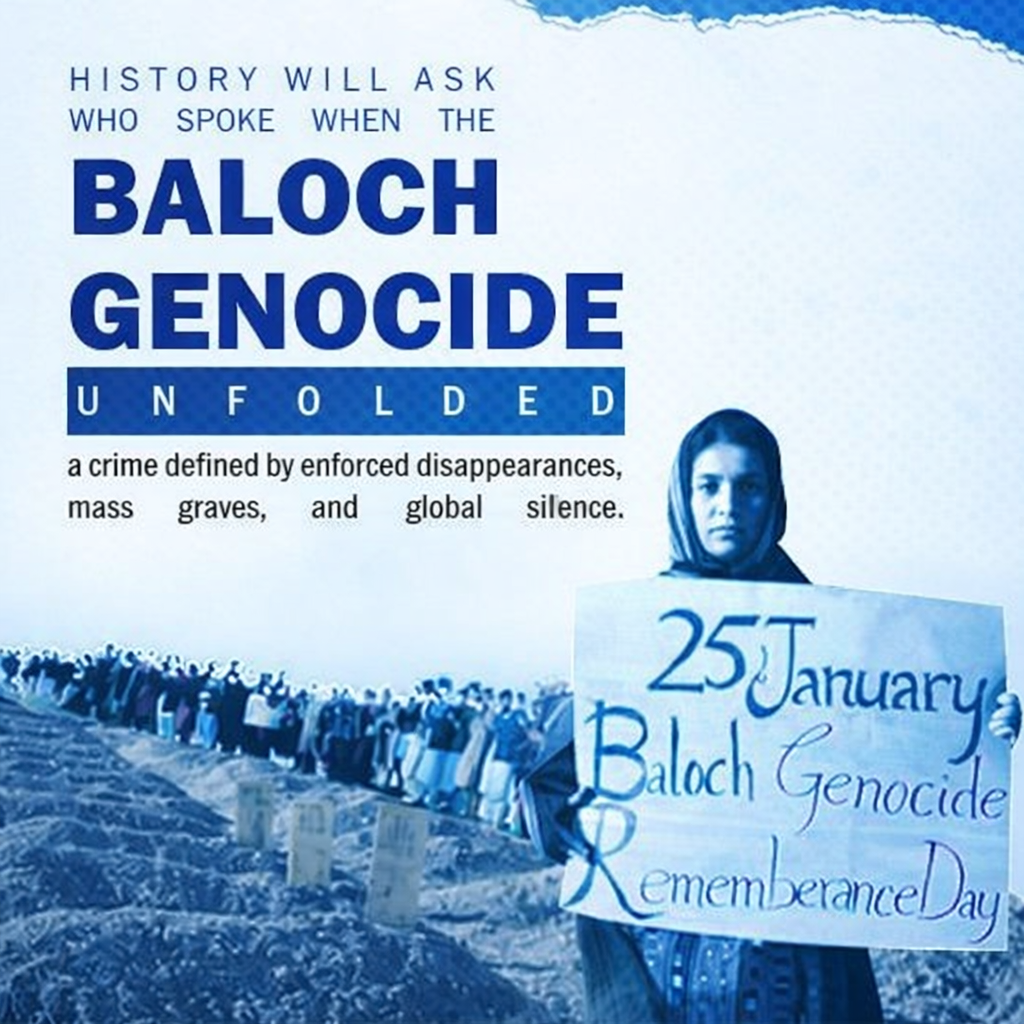
History will not ask how many statements were issued, how many conferences were held, or how carefully worded the expressions of concern were. History will ask only one question: who spoke when the Baloch genocide was unfolding—and who chose silence.
This could have remained a matter of political repression if it had stopped at arrests, bans, and court cases. But it did not. Arrests turned into enforced disappearances. Disappearances turned into bodies. Bodies turned into mass graves. And mass graves were met not with accountability, but with denial and silence. At this point, calling it “just a narrative” is not analysis—it is an escape from responsibility.
If this were merely a security policy, women suffering from polio would not be abducted. Pregnant women would not vanish. Teenage girls would not become enemies of the state. Children, elders, men and women alike would not be treated as expendable. When an entire population is subjected to collective punishment without distinction, the language of repression collapses. What remains is genocide.
In the same year that enforced disappearances, targeted killings, and mass graves intensified, mineral extraction deals were quietly signed. In the same year, laws were rushed through the Balochistan Assembly overnight. In the same year, detention centers were given legal legitimacy. These developments did not occur in isolation. They are interconnected components of a single project: to empty the land and extract its resources without resistance.
Tutek was not an anomaly. It was a warning. Over a hundred unidentified bodies buried without names, without justice, without answers for families still waiting at their doors. That logic did not end there. It continues—year after year—through disappearances, staged encounters, and unmarked graves scattered across deserts and graveyards.
This is not merely state policy. It is a moral collapse. Silence in such moments is not neutrality—it is participation. Those who do not speak are not innocent. Those who refuse to ask questions are not unaware. History records such processes with brutal clarity, and it gives them a name: genocide.
The dead do not return. Trauma does not dissolve. Even when wounds close, scars remain. Pain becomes memory, carried across generations. Yet one possibility still exists: further killing can be stopped. Further disappearances can be challenged. This requires no weapons—only truth, and the courage to reject narratives that justify violence.
Between the continuation of the Baloch genocide and the expanding state narrative that sustains it, every conscious human being is called upon to act—to prevent Balochistan from becoming a collective graveyard, to break the media blackout, and to keep truth alive against systematic falsehood.
January 25 marks the remembrance of the Baloch genocide. Even if mass gatherings are impossible under this semi-militarized reality, testimony remains possible. The pen still exists. Speech still exists. Conscience can still be awakened.
Truth-telling against false narratives is a struggle. And this struggle is not over. It is one that history will remember—by who stood, and by who chose silence.


About the Author