Pakistan’s urban middle class—a sprawling demographic of journalists, lawyers, academics, digital creators, and merchants—often frames itself as an external moral fortress. This “intelligentsia” projects an identity rooted in justice, human rights, and resistance against tyranny. Yet, beneath this self-image lies a complex contradiction: a “selective consciousness” that functions with remarkable efficiency for distant causes while falling into a calculated stupor when faced with the tragedies within its own borders.
The Geography of Empathy
The vibrancy of Pakistan’s moral outrage is often determined by geography. We have seen this civil society mobilize with immense emotional labor for the residents of Gaza, the Muslims of Kashmir, and the Rohingya in Myanmar. When Israeli aggression strikes Palestine or Hindutva policies marginalize Indian Muslims, Pakistan’s digital landscape and physical squares fill with lamentations and solidarity.
Similarly, scenes of potential aggression against Iran trigger fierce condemnation. This sensitivity creates a sense of moral superiority—the image of a society with an awakened global conscience. However, when the gaze shifts from global panoramas to the local geography of Balochistan, this narrative fractures. The same conscience that weeps for distant lands suddenly adopts a posture of “cautious distance” or outright apathy.
The Hierarchy of Suffering
The crisis in Balochistan—defined by enforced disappearances, extrajudicial killings, and pervasive military surveillance—contains enough horror to jolt any living conscience. In 2025 alone, reports alleged that approximately 1,200 Baloch citizens were forcibly disappeared. These are individuals absorbed into an invisible carceral system without legal recourse or the guarantee of return.
The statistics grow grimmer: over 1,700 Baloch citizens were reportedly killed after being labeled “terrorists.” Yet, the families of the deceased tell a different story—one of “staged encounters” where individuals already in state custody are murdered and framed. The case of Hamdan Baloch from Lyari, Karachi, stands as a haunting testament; despite police admitting to his custody in court, his death was eventually buried in an ambiguous state narrative.
The Law as an Instrument of Lawlessness
State repression is not limited to physical disappearance; it extends to the legal strangulation of any voice that dares to speak. Families of the disappeared—mothers, sisters, and daughters—who take to the streets are denied the right to protest. Press clubs, symbols of free speech, often slam their doors shut.
In Balochistan and Karachi, peaceful political struggle is systematically criminalized. Leaders of the Baloch Yakjehti Committee (BYC), such as Dr. Mahrang Baloch, face dozens of charges ranging from sedition to terrorism. By placing activists on the “Fourth Schedule” (a terrorist watchlist), the state renders their very identity suspicious. As Gayatri Spivak famously asked, “Can the Subaltern Speak?” In Pakistan, the subaltern speaks, but the state ensures their voice is treated as a crime.
The Manufactured Narrative
This silence is not accidental; it is a “discursive power,” as Edward Said described, where power is maintained not just by bullets but by the control of information. The mainstream media either ignores Balochistan or frames every act of civil resistance as an extension of militant groups like the BLA.
By conflating peaceful activists with armed insurgents, the state creates a “security lens” that justifies collective punishment. This is the height of hypocrisy: the same urban intelligentsia that rightly decries “Islamophobia” in the West—arguing that the actions of a few should not marginalize an entire population—readily accepts the collective profiling of the Baloch people.
The Loneliness of the Long March
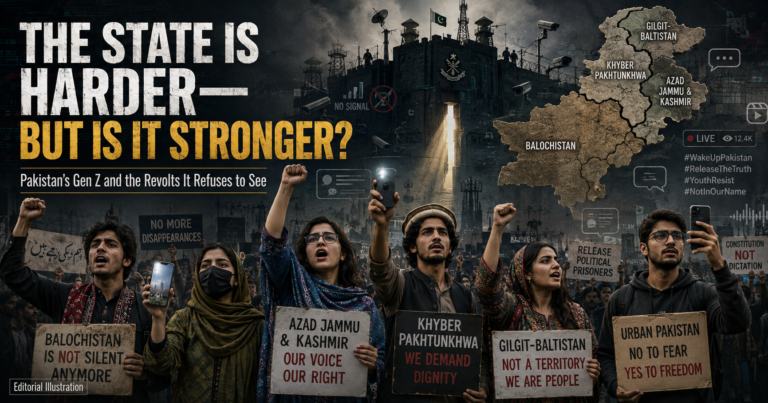
The most naked display of this apathy occurred during the Long Marches led by Mama Qadeer and later by Dr. Mahrang Baloch. These families walked from Quetta to Islamabad, carrying the physical and emotional weight of their missing loved ones.
When they reached the twin cities of Rawalpindi and Islamabad—hubs of millions—not even a few hundred residents stood with them. Instead, they were met with water cannons, police batons, and a state-sponsored “parallel camp” designed to malign them. While these families shivered under open skies in the bitter winter rain, the urban “conscience” stayed indoors.
The Literary and Intellectual Void
This void extends into the arts. Unlike other societies where literature serves as the ultimate witness to tyranny, Pakistan’s “literary stars” have largely ignored the Baloch tragedy. Popular writers who have written extensively on the Partition of 1947 or revolutionary figures like Bhagat Singh have failed to make the ongoing Baloch agony a creative priority.
This is what Karl Marx termed “False Consciousness”—a state where the oppressed (or the middle class) adopt the ideas and biases of the ruling class as their own. Silence, as Jean-Paul Sartre noted, is a choice. And in the face of systemic erasure, silence is indistinguishable from complicity.
Conclusion: The Mirror of History
Balochistan is no longer just a territorial issue; it is a mirror held up to the face of Pakistan’s civil society. It reveals the true shape of our collective conscience. A state that pushes a segment of its citizenry into the darkness of siege and silence is undoubtedly in crisis—but a society that justifies or ignores that darkness is in an even deeper state of decay.
History has a meticulous way of keeping records. It archives not only the actions of the oppressor but also the silence of the bystander. When the time for reckoning comes, the question will not only be “Who committed the crime?” but “Who stood by and watched in silence?”
About the Author