When Every Particle Proclaims the Struggle: The Cry of Pash’s Blood
By Muhammad Amir Hussaini
Author’s Note: The Echoes of a Crimson Dawn
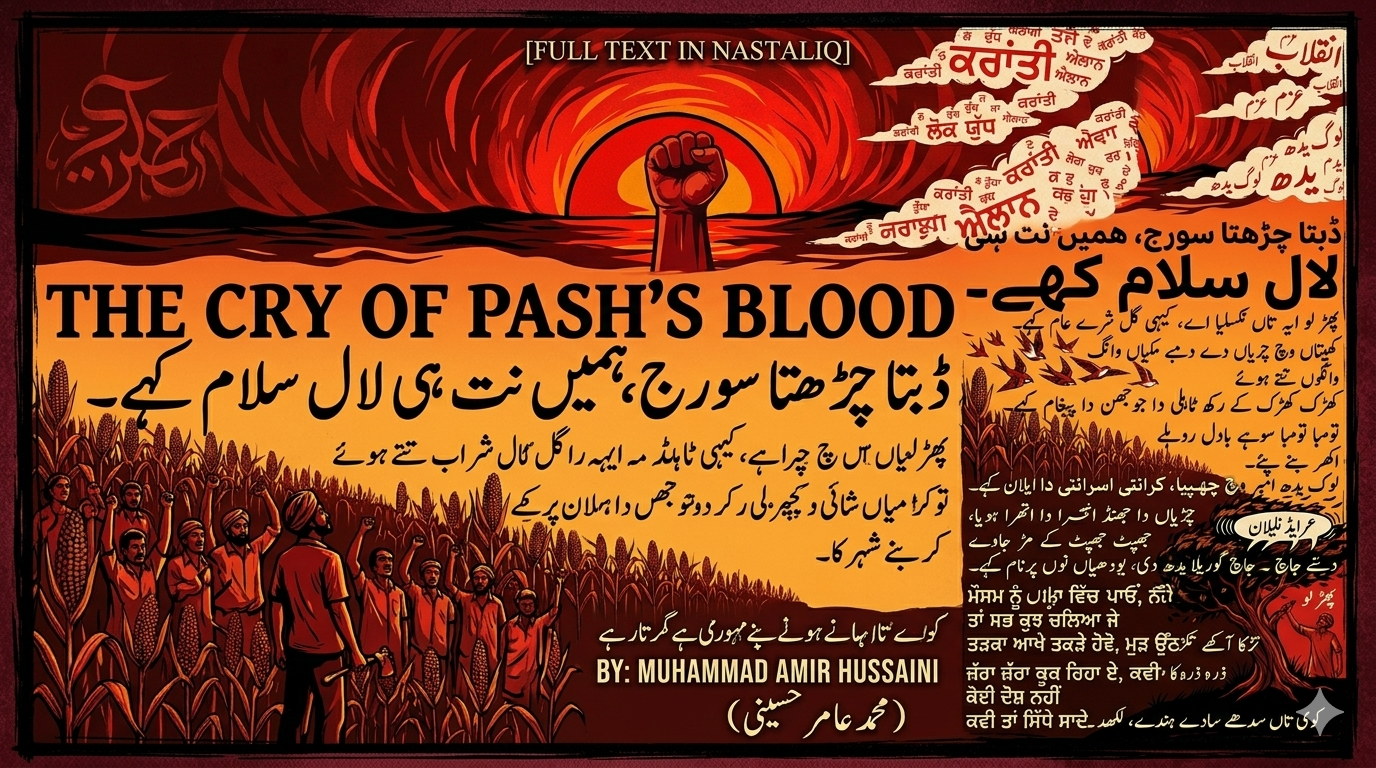
This piece bridges two eras of resistance, transposing the revolutionary imagery of the 1970s Punjab poet Pash onto the contemporary struggle in Balochistan. Although my linguistic roots are in Urdu, Haryanvi, and Awadhi rather than Punjabi, the pulse of these verses transcends dialect. Just as the state once tried to “handcuff the sun” by labeling every cry for justice as a “Naxalite” conspiracy, we see the same pattern today. This writing asserts that rebellion is not an imported product but the organic scream of the earth when oppression becomes unbearable; the poet is merely the scribe of this inevitable truth.
Pash’s poem is not merely a collection of words; it is the outcry of that crimson blood which knows how to look a tyrannical system straight in the eye. It is a portrait of the Punjab of the 1970s, where the sparks of revolution set hearts ablaze.
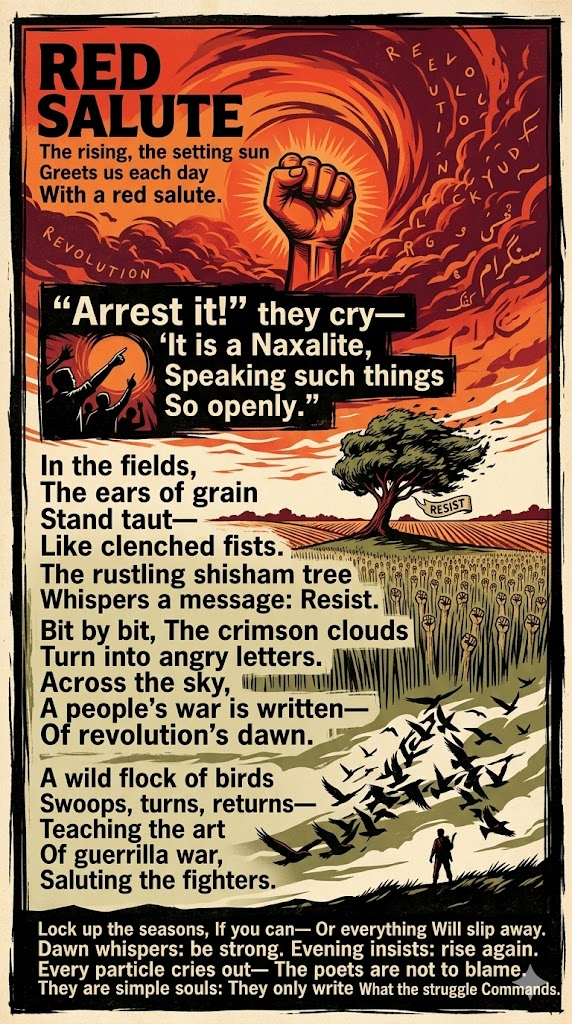
Pash suggests that when the conscience awakens, every element of the universe becomes a rebel. The sun, which until yesterday was just an excuse for the day to begin, now raises its fists every morning and evening to offer a “Lal Salaam” (Red Salute). This sun is no longer bound by your oppressive laws—it has become a Naxalite! The state’s functionaries are bewildered, wondering how to handcuff the sun when it openly broadcasts the call for rebellion.
Look toward the fields! The ears of the fodder crops, which once swayed flexibly, now stand rigid—as if a farmer has clenched a fist against injustice. When the leaves of the Shisham tree rustle in the wind, they do not sing a lullaby; they distribute a message of struggle (Joojhan). The clouds in the sky no longer just pour rain; they have become crimson letters filled with rage, writing the advertisement of “People’s War” and “Revolution” across the chest of the sky.
Nature itself has become a master of guerrilla warfare. The furious flocks of birds, when they suddenly swoop and dive, teach the art of striking the enemy. Pash warns the rulers: “O masters! If you wish to stop this revolution, then go and imprison the very seasons of this earth, for now the dawn challenges you and the twilight gives the courage to rise again.”
In the end, Pash does not declare the poet’s innocence; rather, he states a profound truth: the poet is merely a medium. The “guilty” party is this soil, every particle of which is screaming for rebellion. The poet is no magician; he only writes what the people’s “Sangram” (Struggle) compels him to write.
O Youth! If there is heat in your blood, then rise! For when every particle of the earth begins to speak, silence becomes more dangerous than death.
When Blood Speaks: State Astonishment and Pash’s Proclamation
Today, Pakistan’s civil society, state agents, and court-appointed intellectuals look upon the struggle in Balochistan with the same bewilderment and shock with which the Indian bourgeoisie viewed the Naxalbari movement during Pash’s era. They wonder: what is this beautiful revolutionary crimson in the eyes of these educated Baloch youths, these poor shepherds, these fishermen, these courageous women, and the workers in the mines?
The state’s propaganda machinery today labels every voice raised for its rights as a “BLA terrorist,” exactly how the Indian government used to malign every revolutionary voice as “Naxalite.” In the eyes of the state today, every Baloch boy or girl who touches a book by Karl Marx, Lenin, Che Guevara, Frantz Fanon, or Sartre is a terrorist. For them, the publisher who prints these thoughts is a “proxy,” and the bookseller spreading knowledge is a “criminal.”
Court journalists and salaried intellectuals of the government still recite the same old script: “These are all bought-and-paid-for people” or “They are hired by the neighboring country.” They blame Balochi and Brahui poets, claiming their verses have turned the youth into rebels. They do not understand that rebellion does not happen because someone says so; it happens when the walls of oppression exceed all limits and the very earth begins to speak.
Pash’s poem is a resounding slap across the faces of today’s rulers and their courtiers. Pash showed that when you start calling the sun a “Naxalite,” you should understand that your system has grown old and decayed. If you want to stop the revolution, then go ahead—imprison the mountains of Balochistan, the waves of its sea, and its pathways! For now, even the weather there sings the song of rebellion.
The poet is not at fault. The culprit is your own tyranny, which has now become a “Lok Yudh” (People’s War) and is knocking at your door.
The Poem: The Rising and Setting Sun
Red Salute
The rising, the setting sun
Greets us each day
With a red salute.
“Arrest it!” they cry
“It is a Naxalite,
Speaking such things
So openly.”
In the fields,
The ears of grain
Stand taut
Like clenched fists.
The rustling shisham tree
Whispers a message:
Resist.
Bit by bit,
The crimson clouds
Turn into angry letters.
Across the sky,
A people’s war is written
A proclamation
Of revolution’s dawn.
A wild flock of birds
Swoops, turns, returns
Teaching the art
Of guerrilla war,
Saluting the fighters.
Lock up the seasons,
If you can
Or everything
Will slip away.
Dawn whispers: be strong.
Evening insists: rise again.
Every particle cries out
The poets are not to blame.
They are simple souls:
They only write
What the struggle
Commands.
About the Author