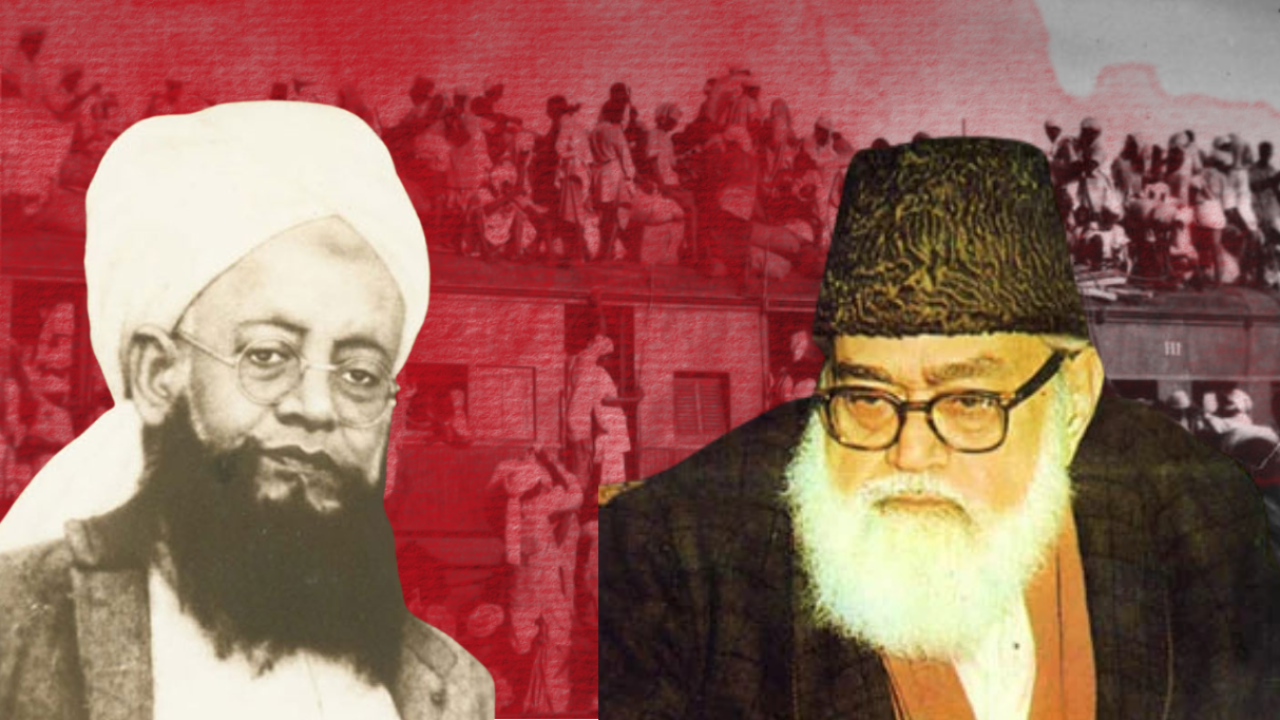
Part 3
The conflict between Maulana Madani and Maulana Maududi over the question of independence

Altaf Parvez
In the wake of Bangladesh’s mass uprising of 2024, the partition of India in 1947 has re-emerged as a subject of renewed political and historical interest. A range of narratives has surfaced that seeks to frame the 2024 uprising not in continuity with the popular movements of 1971 or 1990, but instead by drawing parallels with the political moment of 1947. Some of these voices go further, presenting the events of 1947 and 2024 as part of a shared historical trajectory and claiming joint authorship of both moments.
Against this backdrop, the noted researcher Altaf Parvez turns to the past to interrogate how Islamist parties positioned themselves during the creation of Pakistan in 1947. Today’s third article in this series focuses on the ideological debate between Maulana Maududi and Maulana Hussain Ahmad Madani during the period of the Partition of India.
Maulana Madani and Maulana Maududi were the two principal theorists of the Jamiat Ulema-e-Hind and Jamaat-e-Islami, respectively. These two organisations represent two major streams within the Islamist political sphere in South Asia. One is regarded as the principal caravan of the Deobandi tradition, while the other—though outside the Deoband institutional framework—has also been highly influential in political circles. At the time of the Partition in 1947, both streams, as well as their leading theorists Madani and Maududi, wielded comparable influence.

Jinnah vs Madani: The forgotten Muslim debate over Pakistan 1st Part
Both opposed the Pakistan Movement, though from different positions. Ironically, the younger activists of these traditions today often present themselves as part of a lineage that supported the creation of Pakistan. In the years leading up to Partition, M. A. Jinnah was sharply criticised by both streams—sometimes even at a personal level. We briefly discussed this issue in the previous two instalments.
The British benefited considerably from this three-way conflict, and many scholars have already shown that this triangular dispute played a facilitating role in the eventual partition of India (and Bengal).
It is worth noting that during the 1937 elections, Jinnah once appointed Madani as a member of the Muslim League’s Parliamentary Board, at a time when the Pakistan Movement had not yet gathered momentum. However, once politics rapidly shifted in that direction, Madani soon resigned from the position.
Today’s third instalment, however, examines another intriguing dimension of the ideological debates surrounding 1947 among parties claiming Islamic political representation. Although Maududi and Madani were united in their opposition to Jinnah on the Pakistan question, they were sharply divided over the emancipation of Muslim society and the future of India. While today in Bangladesh the Deobandi tradition and Jamaat-e-Islami often appear politically close, the situation in 1947 was quite different. At that time, Maulana Maududi, Maulana Madani, and their respective followers deeply divided Muslim society.

As noted earlier, the Jamiat Ulema-e-Hind was formed by anti-colonial scholars who regarded the struggle for India’s independence as a primary duty of Muslims. They supported independence while keeping India united. Because of this position, the Jamiat functioned as an ally of the Indian National Congress and was often described as “Indian nationalist” or “composite nationalist.” By contrast, Jinnah’s Muslim League was founded on the idea of “Muslim nationalism,” while Maududi was a fierce critic of all forms of nationalism.
During this period, especially in the 1930s, many Deobandi scholars were reluctant to accept Maududi’s religious interpretations of Islam, arguing that he lacked formal training in these disciplines—although in the previous decade he had been closely associated with Deoband. In fact, the Jamiat’s weekly newspaper Al-Jamiat had once been published under his editorship.
Meanwhile, Madani was at this time an admirer of Gandhi. After Gandhi returned from South Africa, Madani stood alongside him during the Khilafat Movement alliance. At that time Gandhi had not yet formally assumed full leadership of the Congress. In June 1920, the Deobandi scholars of Bombay organised a reception for Gandhi on his return from Africa. Madani’s teacher, Mahmudul Hasan, issued a fatwa encouraging Muslims to participate in Gandhi’s non-cooperation movement.

Jinnah vs Maududi: The forgotten Muslim debate over Pakistan
The closeness between Gandhi and the Deoband scholars, including Madani, later translated into political proximity between the Jamiat and the Congress, and as a consequence their opposition to the Muslim League. This opposition was fundamentally ideological.
In January 1938, Madani argued that the concepts of qaum or ummah represented Islam’s notion of community, yet in the contemporary world nationality (qawmiyyat) was determined primarily by territory rather than lineage or religion. In other words, India itself constituted the homeland (millat) of Muslims, and they did not require a separate territory to form their community. On this basis, they opposed the Lahore Resolution.
The Jamiat’s position was that while the global Muslim ummah included all Muslims worldwide, Indian Muslims as a nation had to seek solutions to their problems within the geographical boundaries of India. Being part of the ummah did not prevent Muslims from also being part of Indian nationality.
Although Maulana Madani and Maulana Maududi stood almost side by side in opposing the Muslim League’s efforts to create a separate state of Pakistan by partitioning India, they disagreed sharply on many related issues. Maududi, in particular, was a strong opponent of Madani’s idea of “composite nationalism,” and he even described Madani’s views on the matter as being of “inferior quality.”(Upamahadesher Swadhinata Andolon o Musalman, Khondo-1, Adhunik Prokashoni, p. 273.)
While the Muslim League was advancing the idea of a separate territorial homeland for Muslims, and Madani was calling for Hindus and Muslims to struggle together against colonial rule and achieve independence jointly, Maududi positioned himself against both and began advocating a distinct nizam, or Islamic order.
Maududi urged Muslims to distance themselves from existing political currents, including both the League and the Congress, at least until the Islamic order he envisioned was established. Madani described such recommendations as utopian. (Barbara D. Metcalf, Maulana Husain Ahmad Madani and Jamaiat Ulama-i-Hind, in Muslims against the Muslim League: Critiques of the idea of Pakistan, Edited by Ali Usman Qasmi and Megan Robb, Cambridge, 2017, p. 45.) He argued that it was a mistaken position for some Muslims to declare the struggle for independence—conducted through ethnic and national unity—as haram and to discourage participation in it. To justify his stance on religious grounds, Madani frequently referred to the example of Muslims living in Medina under a covenant with the Jewish communities.

Similarly, Maududi opposed Madani’s notion of Hindu–Muslim “composite nationalism” or shared culture, contending that art, architecture, and other cultural expressions were not true markers of civilisation. Muslims, he argued, were bearers of a distinct civilisation because their worldview was fundamentally different; they perceived the role of life in the world in a distinctive way. (On this issue, Ali Usman Qasmi analyses Maududi’s views by citing a statement from the March 1933 issue of Tarjuman-ul-Qur’an (p. 26). See: “Differentiating between Pakistan and Napak-istan,” in Muslims against the Muslim League: Critiques of the Idea of Pakistan, edited by Ali Usman Qasmi and Megan Robb, Cambridge, 2017, p. 112.)
According to Maududi, those who were truly Muslim and determined to preserve their Muslim identity should refrain from invoking nationalism or territorial patriotism, and should separate themselves from ongoing movements that sought to dissolve Islamic nationality into geographical nationalism. (Upamahadesher Swadhinata Andolon o Musalman, Khondo-1, Adhunik Prokashoni, p. 152.)
For him, the demand that the subjugated peoples of India should jointly seek independence under the banner of an Indian national consciousness amounted to a rejection of Islamic creed. In his view, the advocates of composite nationalism were attempting to strip Muslim men and women of their Islamic identity. (Upamahadesher Swadhinata Andolon o Musalman, Khondo-1, Adhunik Prokashoni, p. 199.)
Entering this debate, Maulana Maududi also criticised the freedom fighter Maulana Ubaidullah Sindhi, a follower of Shah Waliullah Dehlavi.
To rally Muslims against the Madani camp, Maududi employed several rhetorical strategies, one of which was the invocation of the threat of communism. During this period he warned that, although the Congress was Indian nationalist in form, it was ideologically communist and culturally English, and that Muslim youth would gradually become drawn to these influences. They would, he cautioned, begin replacing traditional forms of address with new ones, greeting others with namaste instead of “good morning”, and wearing the Gandhi cap instead of the hat. (Tarjuman-ul-Qur’an, March 1937, p. 14; April 1937, pp. 12–13)
Elsewhere, he described “swadeshi nationalism” as a blueprint for a way of life that was essentially a confused mixture of Hindu and socialist ideologies, arguing that adopting such nationalism would amount to abandoning Muslim identity. (Upamahadesher Swadhinata Andolon o Musalman, Khondo-1, Adhunik Prokashoni, p. 73.)
Altaf Parvez is a researcher specialising in history. The article has been translated by Samia Huda.
About the Author