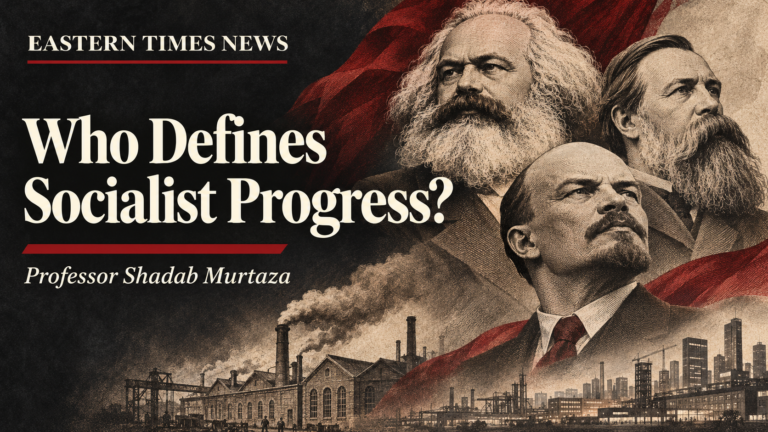
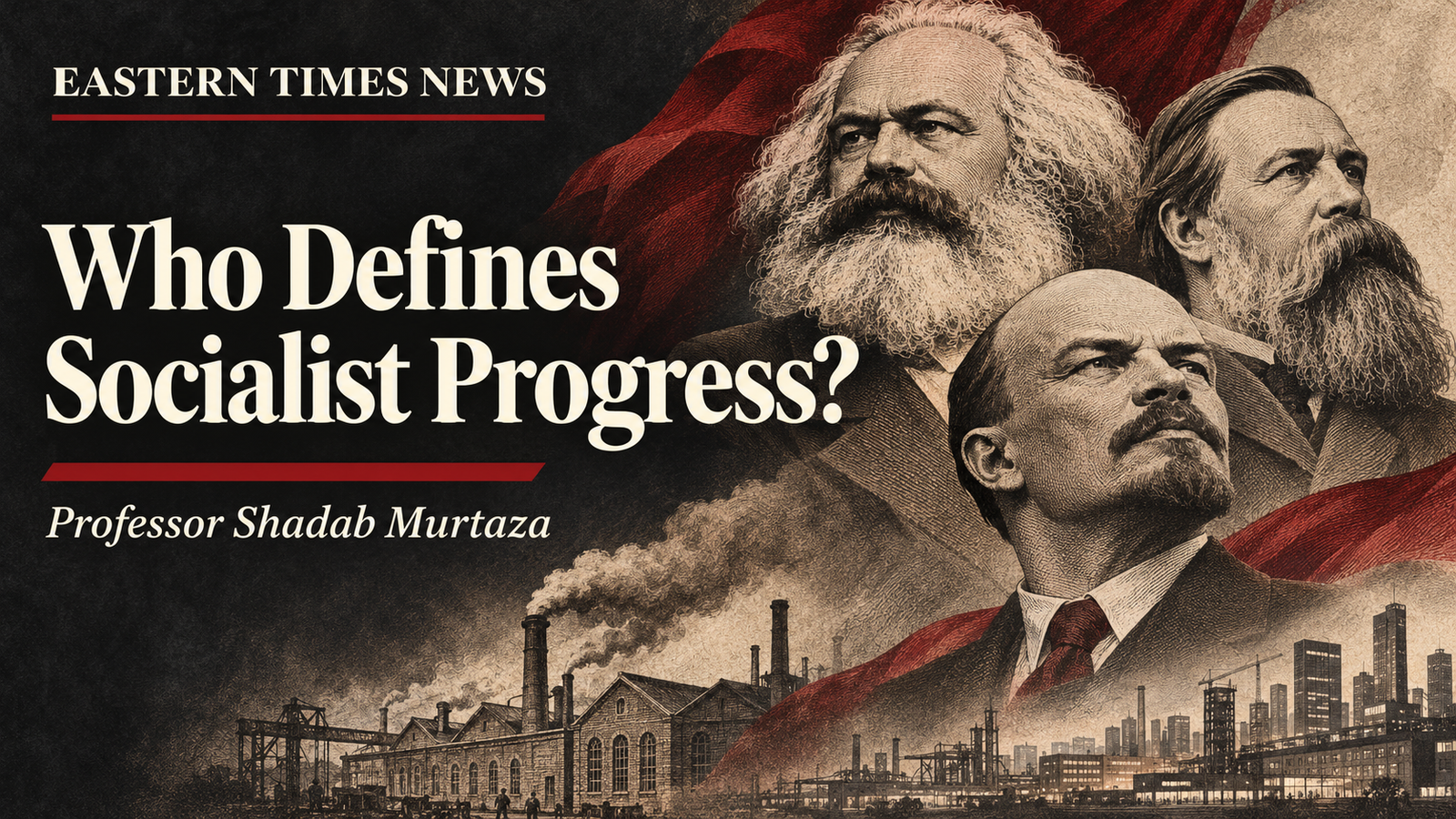
Marx, Engels and Lenin against an industrial skyline. Their debates over reform and revolution still pose a question: who controls the wealth workers create?
Editor’s note
Disputes over what counts as socialism are often presented as a contest between ideological purity and political realism. Professor Shadab Murtaza revisits Marx, Engels and Lenin to ask what that framing leaves out, from the Gotha Programme to contemporary debates over China’s socialist market economy.
There is an irony in the history of socialism. Marx, Engels and Lenin, whose writings were steeped in the practical problems of building political movements, were repeatedly accused of putting doctrinal purity ahead of political reality. The charge was easy to make whenever a critic of compromise asked a difficult question about the price of unity, the limits of reform or the power of private capital. What the charge often evaded was a practical question of its own. If a compromise strengthens the very interests a movement seeks to challenge, on what grounds should it be called progress?
Marx and the Price of Unity
In 1875, two currents of the German workers’ movement came together at Gotha. The merger offered the prospect of a stronger party, and its leaders had good reason to value unity. But the draft programme incorporated ideas associated with Ferdinand Lassalle, including formulations on the distribution of the proceeds of labour. Marx saw a danger in settling disputed principles for the sake of a merger. In his letter to Wilhelm Bracke of 5 May 1875, he argued that the groups could agree on common action and leave the drafting of a common programme until experience had given them firmer ground. Once adopted, a programme would give the public a standard by which to judge the movement. Militant archives Marx’s letter to Wilhelm Bracke
The dispute went to the heart of Marx’s analysis of capitalism. Workers can win higher wages and secure a larger share of what they produce. Those gains matter. The question of who owns the means of production and who decides how the surplus is used remains open. Marx’s analysis of wage labour and surplus value in Capital gives this distinction its force. His critique of Gotha brought it directly into party politics. A promise of fairer distribution tells workers very little about who will control the conditions under which wealth is produced. marxists.org Critique of the Gotha Programme
Engels and the Cost of Short-Term Success
By 1891, when German Social Democracy was preparing the Erfurt Programme, Engels was confronting a related problem. He objected to a draft that skirted the question of political power under the German Empire. He allowed that peaceful development might be possible under certain constitutional arrangements. His objection was to treating that possibility as a strategy for Germany, where representative institutions had limited power. A party that kept quiet about those limits might find itself unprepared when a political crisis forced it to act. marxists.org Engels’s critique of the Erfurt draft
Engels applied a similar test to state ownership in Anti-Dühring. Bismarck’s takeover of Prussian railways gave the state greater control over transport and a source of revenue. Had the railway workers gained control over their working conditions or the use of the revenues? For Engels, the political purpose and class effect of a takeover mattered more than the change of ownership on paper. marxists.org Anti-Dühring
“Every step of real movement is more important than a dozen programmes.”
— Karl Marx, letter to Wilhelm Bracke, 1875. Militant archives“‘Honest’ opportunism is perhaps the most dangerous of all!”
— Friedrich Engels, critique of the Erfurt draft, 1891. marxists.org“And on the whole, during the past year we retreated in good revolutionary order.”
— V. I. Lenin, Eleventh Party Congress, 1922. marxists.org
Lenin and the Candour of Retreat
In the late 1890s, Eduard Bernstein argued that capitalism had shown a capacity to adapt and that organised labour could advance through gradual reform. In What Is to Be Done?, Lenin took up both Bernstein’s revisionism and the Russian current known as Economism. The latter gave priority to economic struggles between workers and employers. Lenin’s objection concerned what happened when that priority became a limit. Workers might build strong organisations to fight over wages and conditions while leaving the wider struggle over political power to others. The First World War later sharpened the dispute, as socialist parties faced the practical consequences of supporting or opposing their own governments’ war efforts. marxists.org What Is to Be Done?, Chapter One
Lenin’s own conduct in government complicates the familiar portrait of the purist. In 1921, after years of war and economic breakdown, the Soviet government introduced the New Economic Policy. It reopened space for private trade and enterprise to help revive production and exchange. At the Eleventh Party Congress the following year, Lenin publicly described the policy as a retreat. He treated it as a way to recover from an immediate crisis and create conditions for a longer transition. His candour matters because it allowed the policy to be judged by what it was doing and what it was intended to achieve. marxists.org Lenin’s report to the Eleventh Party Congress
The Test for Market Socialism
That distinction bears on the debate over China. Its constitution describes the country’s system as a socialist market economy and recognises the private sector as part of that economy. Supporters point to the state’s capacity to direct investment and to the industrial development achieved under the reforms. A Marxist assessment must also ask how decades of private accumulation have affected workers’ power. Who makes investment decisions? Who determines the use of the surplus? What leverage do workers have over those decisions, in privately owned firms and in state enterprises? Those questions give us a way to judge the social consequences of growth alongside its scale. english.www.gov.cn Constitution of the People’s Republic of China, Articles 11 and 15
The utopian premise may lie in expecting a class whose wealth depends on control over investment and wage labour to surrender that power simply because it operates under a Communist Party. A tactical compromise can buy a movement time. A reform can improve millions of lives. The socialist claim depends on what those gains enable workers to control, from the conditions of their own labour to the decisions that govern production and investment. Calling that question purist leaves it unanswered.
Professor Shadab Murtaza wrote this post in Urdu and posted it with his social ID on Facebook.
Editorial sourcing note. The direct quotations follow the linked English editions. The China section uses the constitutional provisions and omits the draft’s undated figures for the private sector and billionaire wealth.
About the Author