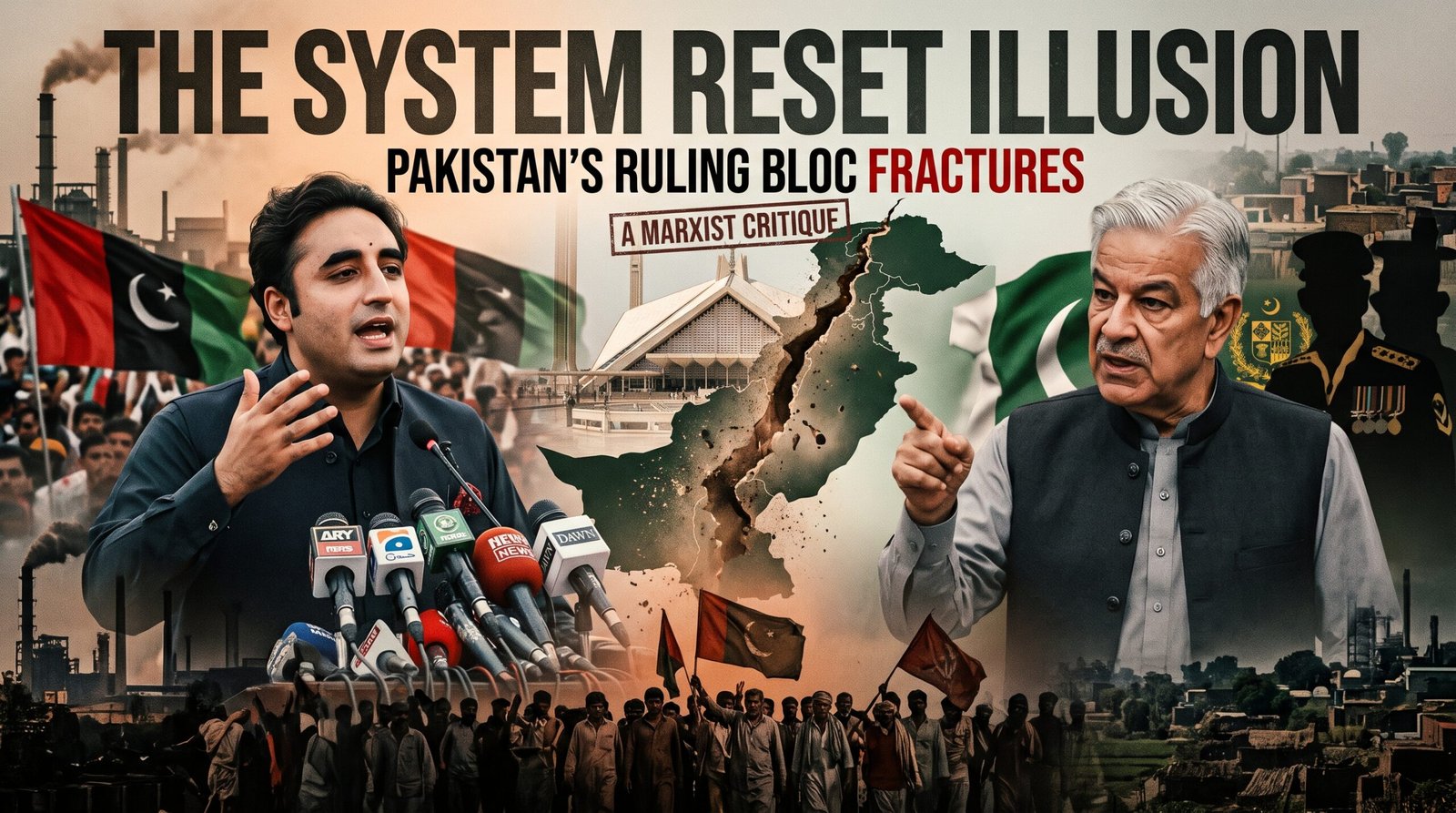
In Pakistani politics, crises of the ruling order rarely announce themselves through revolutionary upheaval from below; more often, they erupt through bitter public recriminations among the very architects of the status quo. Over forty-eight hours in November 2026, an extraordinary exchange between Pakistan Peoples Party (PPP) Chairman Bilawal Bhutto Zardari and senior Pakistan Muslim League-Nawaz (PML-N) ministers stripped away the constitutional pieties of Pakistan’s governing coalition, exposing the raw mechanics of elite bargaining underneath.
Speaking at the Karachi Press Club on November 17, 2026, in response to Interior Minister Mohsin Naqvi’s push for a “system reset” and new administrative units via referendum, Bilawal declared that Pakistan’s governance structure had not collapsed organically, but was deliberately “made to collapse”—candidly admitting his own share of mistakes in that process. Striking the posture of an insurgent democrat, he disavowed the Twenty-Seventh Constitutional Amendment as an exercise in “brute majority,” described the withholding of reserved seats and an election symbol from the Pakistan Tehreek-e-Insaf (PTI) as a “joke” whose seats treasury benches “put in their pockets,” acknowledged Imran Khan as a “political prisoner,” defended Maulana Fazlur Rehman against selective accountability, and warned that any forced division of Sindh would see “blood flow through its streets.”
Within twenty-four hours, the PML-N leadership tore into Bilawal’s newfound radicalism. Defence Minister Khawaja Muhammad Asif invoked the equitable maxim “He who claims equity must come with clean hands,” accusing the PPP of acting as a “partner of the PML-N in the business of government since 2022” where the PPP pockets the “profit” while PML-N and the country absorb the “loss.” Minister of State for Interior Tallal Chaudhry went further, cataloging the PPP’s institutional saturation—holding the Presidency, the Senate chairmanship, and governments in three provinces plus Gilgit-Baltistan—while reminding Bilawal that only a year earlier he had hailed the Twenty-Seventh Amendment’s constitutional court in the National Assembly as “Quaid-i-Azam’s dream” and Benazir Bhutto’s fifty-year legacy. “Sins are not washed away in this manner,” Chaudhry retorted, while Health Minister Mustafa Kamal of the Muttahida Qaumi Movement-Pakistan (MQM-P) accused the PPP of having “crushed” earlier attempts to devolve power through the Twenty-Sixth and Twenty-Seventh Amendments.
In his widely read commentary, “The anatomy of a fracture: Bilawal Bhutto Zardari and the price of expediency,” Barrister Mustafa Mahesar interprets this rupture through classical political realism. Drawing on Niccolò Machiavelli, Edward Gibbon, and George Orwell, Mahesar portrays Bilawal as a Florentine prince who lent his parliamentary legions to fortify a “hybrid edifice,” only to discover that his patron’s consolidation now threatens his own regional citadel. While Mahesar’s realist lens captures the tactical miscalculations of dynastic politics, examining this confrontation alongside the verbatim charges traded by Bilawal, Asif, and Chaudhry through a Marxist historical materialist framework reveals that the crisis is driven not merely by personal betrayal or moral hypocrisy, but by deep structural contradictions within Pakistan’s ruling class bloc.
“Clean Hands” and the Overdeveloped Postcolonial State
Khawaja Asif’s characterization of the post-2022 coalition as “the business of government”—and his reminder that none of its stakeholders possess “clean hands”—is an unintended confession of how the postcolonial state operates in Pakistan. In Marxist state theory, particularly Hamza Alavi’s seminal analysis of the overdeveloped postcolonial state, political instability in Pakistan stems from continuous negotiation and friction among three propertied ruling classes—the indigenous commercial-industrial bourgeoisie (anchored in Punjab by the PML-N), the feudal-agrarian landed aristocracy (anchored in Sindh by the PPP), and metropolitan-imperialist capital—mediated by a dominant military-bureaucratic apparatus.
Mahesar describes the PPP’s support for the Twenty-Sixth and Twenty-Seventh Amendments as a “transaction of pure utility” that backfired. From a Marxist perspective, however, that utility was entirely class-consistent. Amid severe external debt distress, contracting real incomes, and International Monetary Fund (IMF)-mandated austerity, every faction of the ruling bloc required a disciplined, insulated state apparatus capable of neutralizing judicial bottlenecks and suppressing popular resistance. When Bilawal stood in Parliament to celebrate the constitutional court as “Quaid-i-Azam’s dream,” he was providing ideological cover for a ruling-class restructuring designed to insulate executive authority from mass pressure. His sudden November 2026 conversion—condemning “brute majority” and lamenting that treasury benches “pocketed” PTI’s reserved seats to pass two amendments and contemplate a third—illustrates Karl Marx’s observation in The Eighteenth Brumaire of Louis Bonaparte: factions of the propertied classes celebrate authoritarian legalism when it secures their share of state power, and rediscover constitutional morality only when that same machinery is turned against their own turf.
Fiscal Federalism, Rentier Monopolies, and the Battle Over Sindh
Nowhere is the material foundation of this conflict clearer than in the clash over new provinces, referendums, and the Eighteenth Amendment. Both sides cloak their positions in lofty democratic rhetoric: Khawaja Asif frames a referendum on administrative restructuring as “the pinnacle of legitimacy” aimed at devolving power to 250 million citizens, while Bilawal denounces referendums as historically undemocratic tools designed to bypass Parliament and dismantle Sindh.
Beneath this constitutional debate lies an intense struggle over surplus extraction, fiscal rents, and territorial control:
- Provincial Rentier Accumulation: Bilawal’s speech laid bare the financial arithmetic driving the PPP’s resistance. Pointing out that Sindh transfers a Rs585 billion surplus to the Centre, contributes Rs260 billion toward national security, and generates roughly Rs1.7 trillion in petroleum levies, he accused Islamabad of “pickpocket[ing] the province” and “loot[ing] our resources.” For Sindh’s wadera (feudal-landlord) class and provincial bureaucratic elite, the post-Eighteenth Amendment provincial state—alongside monopoly control over Indus water allocations, provincial budgets, and land revenues—is the primary vehicle for reproducing political patronage and economic dominance.
- Centralizing Capital and Urban-Mercantile Restructuring: Conversely, proposals from federal ministers, corporate-state planners, and urban parties like the MQM-P to carve out new administrative units (up to twelve provinces) and construct new strategic canals reflect the push by central state institutions, large-scale corporate agribusiness, and urban-commercial capital to break provincial rentier bottlenecks and centralize control over land, water, and urban fiscal bases.
Tallal Chaudhry’s sharp exposure of Bilawal’s geographical double standard—supporting the creation of a South Punjab province while threatening street bloodshed over dividing Sindh—proves that neither party holds a principled position on federalism. Each defends administrative boundaries where its own ruling-class faction monopolizes state patronage, and demands reorganization where a rival faction holds sway. Most revealingly, when Chaudhry quipped that seventeen years of PPP rule had already “drained the blood of the people of Sindh,” while Asif sarcastically praised Karachi’s ruined infrastructure, they inadvertently highlighted the shared class reality of both camps: whether revenue is retained in Karachi or centralized in Islamabad, the landless Sindhi peasant (hari) and the urban worker remain trapped between feudal exploitation, crumbling public services, and regressive indirect taxes like the very Rs1.7 trillion petroleum levy over which the two parties quarrel.
Bonapartist Cycles and the Illusion of a “Leftward Pivot”
Barrister Mahesar concludes his essay by asking whether Bilawal’s pivot toward populist, federalist themes—calling for a “political reset,” electoral transparency, and the release of political prisoners—can restore his moral authority, warning via George Orwell that political language routinely disguises expediency as principle.
A Marxist reading explains why such pivots are structurally inevitable yet inherently limited. Under Bonapartist or hybrid regimes—where unelected state institutions arbitrate between competing civilian factions—outmaneuvered elites routinely reach for progressive and democratic slogans when “backdoor channels” threaten their regional economic base. Bilawal’s warning that even a “software update” could not force PPP lawmakers to vote for Sindh’s division, alongside his outreach to PTI and Maulana Fazlur Rehman, is a calculated effort to mobilize street pressure and parliamentary leverage in order to force a renegotiation with the establishment.
Yet as long as Bilawal’s “political reset” leaves untouched feudal land tenure, elite tax exemptions, privatization, and the suppression of independent trade unions, it represents a realignment within the ruling oligarchy rather than an emancipatory break from it. Khawaja Asif’s taunt about “clean hands” and Bilawal’s confession that the system was “made to collapse” together confirm that Pakistan’s crisis is not an accident of bad governance, but the organic product of a ruling bloc incapable of resolving the country’s economic breakdown. Until Pakistan’s working classes organize independently of dynastic, feudal, and military-corporate factions, every promised “system reset” will remain a struggle over how the surplus extracted from labor is divided at the top.
About the Author