From the very first day, Pakistan’s 1973 Constitution neither fully reflected the character of a people’s democratic republic nor did it construct a federation that recognized Pakistan as a multi-national federal state. Instead, it reduced the relationship between the Federation (Centre) and the provinces to a mere administrative division. This conception of the state echoed the same formula the British colonial empire introduced through the Government of India Act, 1935.
Although the 1973 Constitution abolished the One-Unit scheme introduced in the 1956 Constitution, it forcibly merged the State of Bahawalpur into Punjab without even considering the consent of the people of Bahawalpur.
As a citizen of Pakistan, I have always believed that this Constitution cannot become a true democratic people’s Constitution unless amended to explicitly recognize Pakistan as a federation composed of five major national units — Punjabi, Saraiki, Sindhi, Baloch, and Pashtun. It must also categorically declare six national languages — Urdu, Punjabi, Saraiki, Sindhi, Pashto, and Balochi.
Without these provisions, the Constitution remains incomplete.
As a citizen, I also object to the fact that although the Constitution claims equality of citizenship, it contradicts itself by adopting the “Objectives Resolution” as its preamble and naming the country the Islamic Republic of Pakistan instead of People’s Democratic Republic of Pakistan. The inclusion of religion pushes the state toward theocracy, contrary to democratic principles. By defining citizens through religion, the Constitution enables discrimination and legitimizes legislation that prosecutes people based on religious identity and enforces one specific interpretation of belief.
Despite these flaws, we abided by the Constitution in the hope that one day it would evolve into a genuine federal democratic charter.
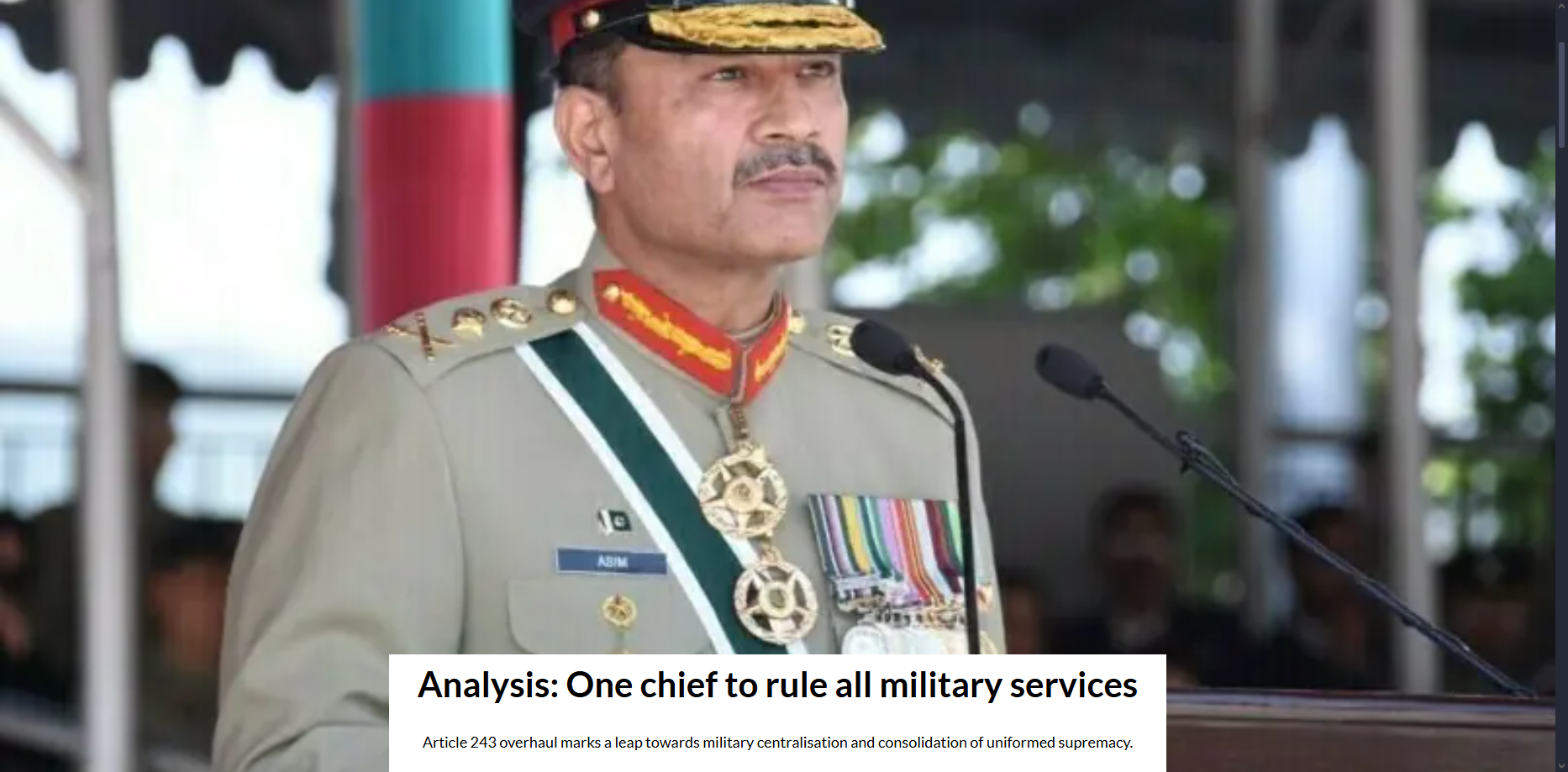
This hope has now been shattered by those political parties that support the present ruling setup. They have indicated their willingness to amend Article 243 — the constitutional guarantee of civilian supremacy — by abolishing the Joint Chiefs of Staff Committee and creating a “Chief of Defence Forces” with immunity from any trial, effectively nullifying Article 6.
Pakistan’s military establishment has interfered in the political process since 1958. It engineered the 1970 elections to prevent any party from gaining a clear majority. But the people’s overwhelming mandate for the Awami League defeated those plans. Instead of transferring power, the military crushed the parliamentary majority through state violence, triggering the uprising of East Bengal’s majority and ultimately dividing the country.
Despite the presence of Article 6 and Article 243 in the 1973 Constitution, the military trampled the Constitution merely four years later, and an unelected parliament legalized eleven years of authoritarian rule through the Eighth Amendment. The entire decade of the 1990s was marred by rigged elections and manipulated changes of government.
On July 5, 1977, democracy was taken hostage. The military seized the presidency, foreign affairs, and defence, and controlled internal and external policies. On October 12, 1999, the Constitution was again suspended, and the military ruled directly for eight years. It controlled the legislature, bureaucracy, and a subordinate judiciary.
After 2008, despite being forced to relinquish the Presidency and the Prime Minister’s Office, the establishment impeded meaningful provincial devolution, manipulated foreign and defence policy, and ensured that the judiciary never achieved true independence under the 18th Amendment.
Between 2013 and 2018, the establishment launched a project aimed at turning parliament into a rubber stamp and subordinating the civilian administration down to the district level. Internal power struggles slowed its completion, but from 2021 to 2024, the establishment regained full control over parliament, executive, and judiciary. It removed internal dissent, sidelined judges, and passed the 26th Amendment.
Today, through the 27th Amendment, the establishment seeks to eliminate constitutional guarantees of civilian supremacy and confer absolute constitutional authority on the Chief of Defence Forces. It would legalize military dominance and provide blanket immunity from constitutional deviation or suspension — even though Article 6 has never truly been enforced.
After two martial laws spanning nineteen years and anti-democratic amendments enforced by coercion between 2018-2025, the 1973 Constitution has already lost much of its democratic character. The establishment now controls the civilian security and intelligence apparatus through the Anti-Terrorism Act, PECA, and other laws; controls economic and financial policy through special councils; and dominates agriculture and livestock through the Pakistan Green Initiative. It has bypassed democratic institutions in irrigation policy and empowered loyalists over civil ministries.
Now the proposed 27th Amendment aims to erase what remains of democratic substance in the Constitution.
As a writer, I feel Pakistan has reached a point where political and social struggle must be relaunched to make this country a true people’s democratic republic.
The tragedy today is that Pakistan lacks a political force committed to a democratic people’s revolution. All major parliamentary parties suffer from extreme compromise and have even failed to restore student unions since their ban in 1984 — the most basic nursery of democratic politics. Trade unions have been erased from factories and offices. Parties themselves are run by family autocracies, eliminating the breeding of genuine political workers.
Press and bar associations have also been reduced to pressure groups. It is now nearly impossible for a lower-middle-class journalist or lawyer to become a union leader, just as it has become nearly impossible for an ordinary citizen to become a legislator.
Pakistan needs genuine democratic political parties, real student politics, bar politics, journalism unions, and labour unions so that students, workers, farmers, lawyers, and journalists can rebuild the institutional foundations of people’s democracy.
Liberal intellectuals, writers, and poets must establish independent writers’ associations in major cities to awaken society to democratic struggle. This journey is neither short nor easy. If conscientious writers form such a platform, I will be part of it. Individually, I have always stood for democratic rights, and I will continue to do so. I never served as a scribe or tenant to compromise-ridden political leadership — nor will I now.
Are you ready to do the same?
Muhammad Aamir Hussaini
About the Author